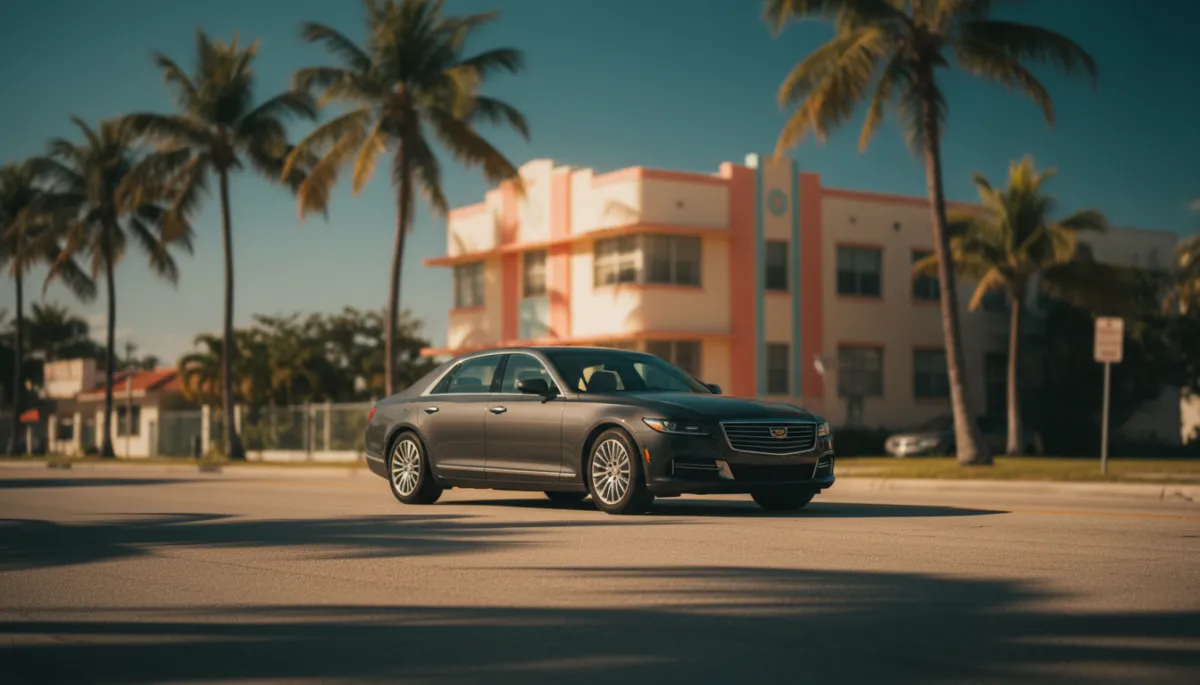
Why Miami Cars Run Hotter Than You Think — And the Effortless Fix That Works While You Drive

It's 2:17 PM on a Thursday in Flagami.
You've been inside for three hours — a meeting ran long, lunch stretched, the usual Miami pace. Now you're walking back to your car, parked in a lot off NW 8th Street with no shade in sight.
You reach for the door handle. It burns.
You open the door and a wall of trapped heat rolls out — that distinct, stomach-dropping blast that tells you the interior has been cooking since you parked. The dashboard thermometer reads 147 degrees. You sit down anyway, your shirt immediately sticking to the seat.
This is Miami in summer. This is what every untinted car in Flagami, Westchester, Doral, and the neighborhoods around Miami International endures every single day from May through October — and honestly, most of the year.
But here's what most drivers don't know: this doesn't have to happen. Not because you need to find shade. Not because you need a better air conditioner. Once you have the right window film installed, your car simply handles the heat on its own — automatically, every day, without you ever thinking about it.
That's the story of heat rejection. And it starts with a science lesson you'll wish someone had given you years ago.
What's Actually Cooking Your Car
Most people blame the sun. That's fair — but it's not the whole picture.
When sunlight hits your car, it arrives in three forms: visible light (what your eyes see), ultraviolet radiation (what slowly destroys your interior), and infrared radiation — IR for short. That last one is the silent driver of cabin heat.
Infrared light is invisible. You can't see it, but you feel it as heat. And here's the number that most tint shops never bother to explain: infrared radiation accounts for roughly 53% of the total solar energy that strikes your vehicle.
Standard automotive glass — the kind your car came with from the factory — blocks almost none of it. UV? A little. IR? Essentially nothing.
So when you park near Miami International for a morning meeting, or along Coral Way in the mid-afternoon, or on a Westchester side street with no tree cover, the sun's infrared energy passes straight through your windows and gets absorbed by every surface inside. The dashboard. The steering wheel. The leather seats. The headliner. Everything becomes a radiating heat surface.
A closed car in Miami's summer sun can reach interior temperatures of 140°F to 160°F within an hour. That's not discomfort — it's the steady, daily destruction of every surface inside your vehicle. And standard glass offers you no defense against any of it.
Why Regular Window Tint Isn't Enough
At this point, maybe you're thinking: "I've had tint before. It didn't really make that much difference."
You're probably right — and the reason matters.
Most budget window tint uses dyed film: a layer of color pigment sandwiched in adhesive. It blocks visible light (which is why it looks dark), but it absorbs heat rather than rejecting it. That absorbed heat radiates inward into the cabin. You've blocked the glare but barely moved the needle on temperature.
Then there's metalized film, which does better with IR rejection — but brings new problems. Metallic particles interfere with GPS signals, satellite radio, and cell reception. For drivers across Doral, Sweetwater, and the MIA area who depend on navigation every day, that's a trade-off nobody wants to make.
And both types fade. Miami's UV intensity is relentless. The same radiation that cracks dashboards and fades upholstery will degrade dyed and metalized films within two to three years. You end up replacing the tint, spending money twice, and starting over with the same inferior product.
The drivers across West Miami, Little Havana, and the 33126 zip code who've gone through two or three tint jobs without real satisfaction have usually been buying the wrong technology — not the wrong brand.
The 3M Ceramic Difference — Protection That Just Works
3M Ceramic Series window film uses nano-ceramic particles — not dye, not metal — embedded throughout the film. These particles block infrared radiation at the molecular level, rejecting heat before it ever enters your cabin.
In practical terms, that means:
- Up to 99% UV rejection — from day one, every drive, automatically
- Significant IR heat rejection — measurably cooler cabin temperatures, often 10–15°F lower
- Zero signal interference — GPS, Bluetooth, satellite radio, and mobile reception all work exactly as before
- No fading, no bubbling, no purpling — ceramic maintains its clarity and performance over years of South Florida sun
And here's what makes this genuinely different from every other upgrade you might consider for your car:
You don't have to do anything.
Once the film is installed, it works. Automatically. Every morning when you leave for work from Flagami or Sweetwater. Every afternoon when the summer sun hammers your parking spot in Doral or along a Westchester side street. Every time you're sitting in traffic on the Palmetto heading west into that brutal afternoon glare. The film is blocking infrared, eliminating UV, and keeping your cabin cooler — without any action on your part, on every single drive.
One appointment. One installation. Then years of effortless protection.
This isn't a gadget you have to remember to use. It's a permanent upgrade to how your car handles the South Florida climate — and you benefit from it every day without ever thinking about it again.

What Ceramic Film Actually Protects
The comfort benefit gets the headlines — but the full value of 3M ceramic film goes much deeper.
Your leather seats and interior surfaces. UV and infrared together are the primary cause of leather cracking, faded upholstery, and deteriorating headliners. Block both, and you've extended the life of every interior surface in your car — which matters even more in Miami's year-round sun exposure.
Your dashboard and steering wheel. That warped, brittle dashboard and the steering wheel that's too hot to grip at 2 PM — both are the result of daily infrared bombardment. Ceramic film addresses this at the source, not by cooling the air, but by blocking the radiation before it creates the heat in the first place.
Your safety on Miami roads. Glare reduction is a quietly critical benefit — especially on the afternoon westbound commute on I-836, the Palmetto, or US-1 through South Miami and Coral Gables. Less glare means less eye strain and a meaningfully safer drive through Miami's most congested corridors.
Your car's resale value. A well-maintained interior — no faded leather, no cracked dash, no sun-damaged headliner — commands noticeably better resale prices. For drivers in Doral and Coral Gables protecting luxury or late-model vehicles, ceramic film is one of the highest-return upgrades available.
Serving Miami-Dade: From Flagami to Coral Gables and Beyond
If you've been searching for the best window tinting near Flagami, 3M ceramic film in the Little Havana area, or a reliable car tint shop near you in the 33126 zip code — there's one name that comes up consistently across Miami-Dade.
Best Window Tinting & Car Accessories has been serving South Florida drivers from their shop at 7284 NW 8th Street — right in the heart of the NW 8th corridor, easily accessible from Flagami, West Miami, the Airport area, Little Havana, and all points across the county.
As a 3M Authorized Dealer, the film is genuine, the installation is performed by trained technicians, and the warranty is backed by 3M directly — not just a shop's word.
Their 4.8-star rating across 812+ Google reviews reflects consistent, in-shop precision — no mobile tinting, no rushed parking lot installations. Drivers from Westchester to Sweetwater to Doral keep coming back — and sending their neighbors — because the work is done right, in a controlled environment, every single time.
They handle ceramic and standard window film for cars, trucks, and SUVs, as well as commercial window film for offices near Doral and residential film for condos in Coral Gables and South Miami baking in the afternoon sun.
If you've been putting this off — waiting until the summer really gets bad — it's already that bad. The car you're driving today has been losing a little more interior integrity every time it sits in the sun unprotected.
One appointment fixes that. Permanently.
Ready to Keep Your Car Cool This Miami Summer?
Best Window Tinting & Car Accessories serves drivers across Miami-Dade — from Flagami and Little Havana to Westchester, Doral, and Sweetwater.
📍 Address: 7284 NW 8th St, Miami, FL 33126
📞 Call or Text: 786-917-2171
🌐 Website: bestwindowtinting.weebly.com
⭐ 4.8 Stars | 812+ Google Reviews — Read our reviews
In-shop service only — no mobile tinting. Walk-ins welcome.
Follow us on Instagram @bestwindowtinting and Facebook Best Window Tinting Miami for before/after shots, tinting tips, and Miami car culture. Leave us a review on Google — it means the world to us: https://share.google/SeejrUMdvt2gHaz2L
