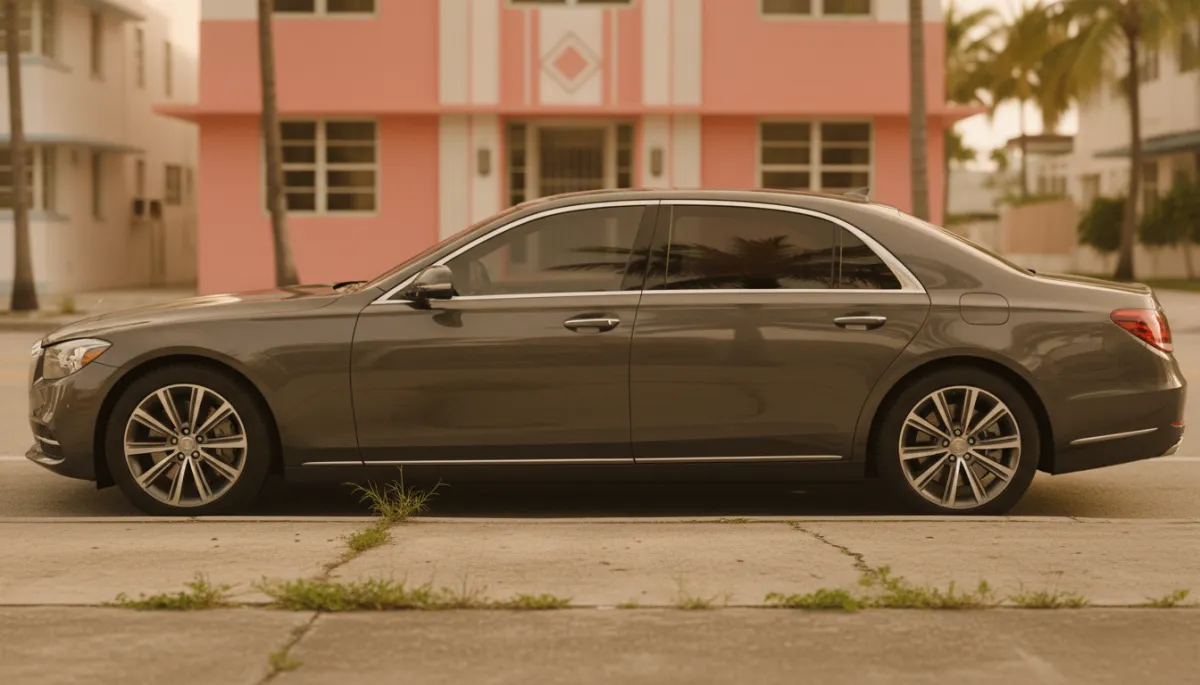
They Laughed When He Got the Cheap Tint — Until Miami Summer Showed Up
They Laughed When He Got the Cheap Tint — Until Miami Summer Showed Up
Carlos had it all figured out. He found a tint shop off Bird Road advertising a full car for $79, cash only, done in an hour. His Flagami neighbors shook their heads. "Should've gone to NW 8th," one of them said. Carlos smiled and pocketed the difference. That was March.
By July, the bubbles appeared along his rear window — small at first, then spreading like trapped air beneath wallpaper. By August, the rear side windows had shifted from charcoal black to a faded purple-gray. By September, the edges were peeling. His dashboard had begun to crack along the top. The leather on the driver's seat was fading — a pale, sun-bleached stripe where the morning sun hit hardest during his Airport area commute.
The $79 he saved cost him $1,200 in repairs and a full redo. No one was laughing.
This isn't a horror story. It's Tuesday in Miami-Dade. It plays out in parking lots across Westchester, in driveways in Little Havana, in Doral office park employee lots every single summer. The climate here does not forgive low-quality window film — and every South Florida sun season, cars pay the price.
Miami Is Not Like Anywhere Else — And Your Tint Needs to Know That
UV Intensity: Miami-Dade regularly hits UV Index levels of 11–12 (classified as extreme) from May through October. This is the intensity that degrades fabric, bleaches interiors, and rapidly breaks down the chemical compounds in low-grade dyed window film. You can see it on any car that's been parked outside in South Florida for a summer or two.
Interior temperatures: A car parked in direct Miami sun on an August afternoon can reach internal temperatures of 130–150°F. Budget dyed films absorb solar energy rather than rejecting it — meaning the film itself gets superheated from the inside out, accelerating adhesive failure and color breakdown.
Humidity cycles: Miami's relative humidity averages 75–80% most of the year. Budget adhesive layers cycle between saturated and dry with every rain-to-sun shift. Over months, this loosens the bond between film and glass — creating the conditions for bubbling, delamination, and edge lift.
Cheap tint might last three years in a dry climate. In Miami, you'll be lucky to get through year one without visible damage.
What Actually Happens to Cheap Tint in Miami's Heat and Humidity
There are three categories of budget window film: dyed, low-grade metalized, and "hybrid" blends that are mostly dyed with a thin metallic layer. Here's how each fails in South Florida:
Dyed film absorbs heat in the dye layer. That dye degrades under Miami's UV intensity — fading from charcoal black to a dull purple-gray, then becoming patchy and inconsistent. The overheated adhesive loosens from the glass, and bubbles form. Small ones first, then growing, then visible from twenty feet away. Most dyed film jobs in Miami look aged within 12–18 months and embarrassing within 24.
Low-grade metalized film avoids the fading problem but creates new ones — signal interference with GPS, Bluetooth, cell service, and SunPass transponders. For anyone commuting on 836 or the Turnpike daily, that's an active nuisance. When metalized film eventually fails, edge delamination tends to be more severe than with dyed film.
Both fail for the same root reason: they were engineered for a climate that is not Miami.
The Real Cost — What UV Is Doing to Your Car Interior Right Now
Most Miami drivers miss this when comparing tint prices: they're not comparing tint costs. They're comparing the cost of protecting everything already inside the car.
UV-A and UV-B radiation — pouring through inadequately tinted glass while you're parked at a Westchester Publix or sitting in Doral traffic — attacks every interior surface simultaneously. Dashboards crack and fade. Leather loses suppleness, cracks along seams, and eventually requires panel replacement. Steering wheel leather grows dry and brittle. Interior plastics discolor at different rates depending on UV exposure angles, creating a mismatched, aged appearance.
For drivers in Coral Gables and Coconut Grove operating luxury vehicles, the numbers speak plainly: a leather interior restoration in a premium vehicle can run $3,000–$8,000. A complete 3M ceramic tint installation — which blocks up to 99.9% of UV radiation — is a fraction of that. Prevention beats remediation every time.
For everyday drivers — the Sweetwater family in a Pilot, the Doral lease holder in an Accord, the South Miami teacher in a decade-old Corolla — interior condition directly affects trade-in and resale value. A UV-damaged cabin drops valuation meaningfully at any dealer or private sale. A protected, pristine interior tells the story of a well-kept car.

What 3M Ceramic Film Actually Does — Without the Technical Jargon
The fundamental difference between 3M ceramic film and budget dyed film comes down to one word: rejection versus absorption.
Cheap film absorbs heat. 3M ceramic film rejects it — at the glass surface, before it ever enters your vehicle.
3M's nano-ceramic technology embeds microscopic ceramic particles throughout the film matrix. These particles reflect and reject solar infrared energy — up to 97% of infrared heat and up to 99.9% of UV radiation, depending on the series. Because the film doesn't absorb heat, it doesn't overheat, doesn't degrade chemically, and doesn't fail at the adhesive layer. What you see on installation day is what you see five years later.
- No signal interference. Non-metallic construction means zero interference with GPS, Bluetooth, cell reception, or SunPass. Works perfectly on Miami's toll roads from day one.
- True color stability. No fading to purple. No patchy inconsistency. The film maintains its appearance and performance for the life of the product.
- Glare reduction. Significantly cuts the harsh glare Miami drivers deal with daily — particularly brutal on I-95, the MacArthur Causeway, and the Palmetto during afternoon and evening drive hours.
- 3M Warranty. As a certified 3M Authorized Dealer, Best Window Tinting backs every ceramic installation with the full 3M manufacturer's warranty covering bubbling, peeling, delamination, and color change.
Six Months vs. Two Years — A Real-World Side by Side
Two cars, both tinted in March on the same block in Little Havana:
Car A — cheap dyed film, $85 installed: By September, rear window bubbles are visible along the defroster lines. By the following spring, rear side windows have gone purple-gray in the corners. By summer of year two, the owner is getting quotes for removal and redo. Total spend: $85 + $120 removal fee + new installation. Interior shows UV damage on the dash and driver's seat bolster.
Car B — 3M ceramic film from Best Window Tinting: Two years in, the tint looks exactly as it did on installation day. The interior is noticeably cooler on entry. The leather is uncracked. The dash is unbleached. The owner hasn't thought about the tint once since they drove away — which is exactly how it should be.
A quick note on Florida tint law (2025/2026): Florida requires a minimum of 28% VLT (visible light transmission) on front side windows for most passenger vehicles, with 15% permitted on rear side and back windows. Best Window Tinting ensures every installation is fully Florida-compliant — and the team will advise you on the exact legal shade for your specific vehicle type at your appointment.
The Neighborhoods We Serve Every Week
Best Window Tinting at 7284 NW 8th Street sits at the center of Miami-Dade's most car-proud communities — and the shop has built its reputation one installation at a time, neighborhood by neighborhood.
Flagami customers walk over or make the five-minute drive and leave the same day with a finished car. Little Havana regulars have been recommending the shop by word of mouth for years — entire families sent by a single satisfied neighbor. Westchester families bring in SUVs and minivans before summer peaks. Doral professionals — many driving late-model luxury imports — trust the 3M name and 812+ verified Google reviews to make the decision. Airport area workers who commute into South Florida sun every morning know that glare reduction is a safety upgrade as much as a comfort one.
Customers also come regularly from Coral Gables, Coconut Grove, South Miami, and Sweetwater. The combination of 3M Authorized Dealer certification, ceramic film expertise, and a shop-only standard — every installation performed in a controlled, dust-free environment — draws drivers from across the county who want the job done right the first time.
If you've been searching for the best window tinting near Flagami Miami, 3M ceramic film in Little Havana, a car tint shop near me in Miami, or ceramic window tinting near Westchester — you've found it.
Visit Best Window Tinting & Car Accessories — Miami-Dade's 3M Ceramic Specialists
Don't wait for the bubbles. Don't wait for the purple haze. Don't let another Miami summer do damage you'll spend twice as much to undo. The call takes thirty seconds — the protection lasts years.
📍 Address: 7284 NW 8th St, Miami, FL 33126
📞 Phone: 786-917-2171
🌐 Website: bestwindowtinting.weebly.com
✅ 3M Authorized Dealer | Ceramic Film | Commercial & Residential Window Tinting | Shop appointments only — no mobile tinting
⭐ 4.8 Stars · 812+ Google Reviews — Leave us a review on Google — it means the world to us.
Follow us on Instagram @bestwindowtinting and Facebook Best Window Tinting Miami for before/after shots, tinting tips, and Miami car culture. Leave us a review on Google — it means the world to us: https://share.google/SeejrUMdvt2gHaz2L
