Why Cheap Window Tint Fails in Miami — And What Smart Car Owners Do Instead
Carlos drove his black BMW down NW 8th Street feeling pretty good about himself.
He'd just saved a hundred dollars on window tint. The shop on Flagler had quoted him $320. The guy near the Flagami swap meet said he'd do it for $189. Carlos went with the Flagami guy. Seemed like a no-brainer.
Six weeks later, he was standing in the parking lot of his office in Westchester, staring at his rear window.
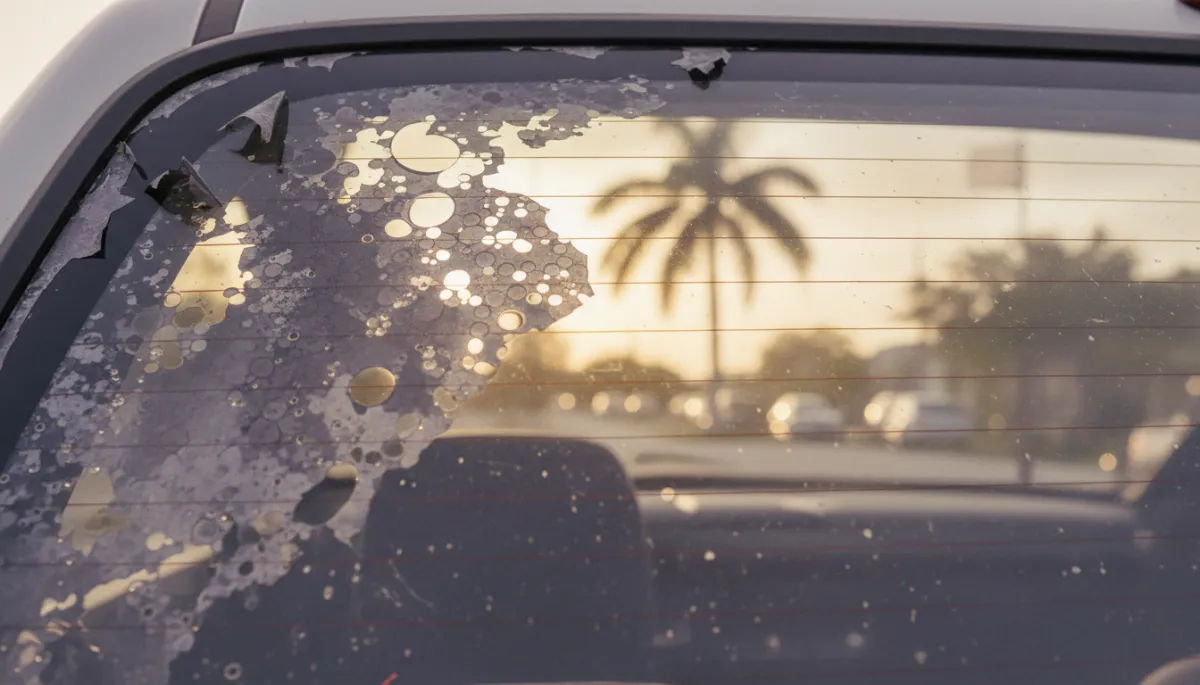
Bubbles. Dozens of them. Small ones clustering near the defroster lines, bigger ones forming along the edges. And the color — the film had turned a mottled purple-gray, like someone had microwaved a plastic bag and pressed it against the glass. He ran his hand along the corner where the film had already started to peel.
"I was embarrassed to pull up anywhere," he told us the afternoon he walked into our shop at 7284 NW 8th St. "I drive a BMW. My back window looks like a gas station receipt."
We hear this story — or some version of it — every single week. Drivers from Sweetwater, Doral, Little Havana, West Miami, Coral Gables, all the way out to the Airport area. And they're not telling it because they made a careless choice. They're telling it because nobody warned them what Miami actually does to cheap window tint.
This post is that warning. And the good news that follows it.

Why Miami Is the Toughest City on Window Tint in America
People who move to South Florida from the northeast, the midwest, even California, are often surprised by how fast their window tint deteriorates. Back home, that $150 tint job lasted five years without a problem. In Miami, it's a mess by year one.
Here's the science behind it.
Miami-Dade sits at a latitude that delivers among the highest UV radiation levels in the continental United States. During peak summer months, the UV Index regularly reaches 10–11 — classified as Extreme. But UV is only part of the assault.
A car parked in direct Miami summer sun sees interior surface temperatures climb to 170°F–200°F. Not air temperature — dashboard temperature, seat-surface temperature. Then there's the ambient humidity: Miami averages 75–80% relative humidity year-round, spiking well above 90% during summer months.
What this means for window tint: you have extreme UV breaking down adhesive chemistry, extreme heat expanding and contracting the film dozens of times each day, and moisture working its way under film edges — all simultaneously, every single day, for years on end.
Most budget window tint was engineered for moderate climates. It has no answer for all three forces hitting at once. The result is what you see on Miami streets every day: purple, bubbly, peeling film on cars that deserved far better.
The 6 Warning Signs Your Tint Is Already Failing
If you've had aftermarket tint installed at a discount shop — especially in the last two years — take a close look at your windows right now. These are the signs your film is already in trouble:
- Bubbling: Air pockets forming under the film. In South Florida conditions, this typically appears within 3–12 months of a poor-quality install. Once it starts, it accelerates rapidly.
- Purple or gray discoloration: Cheap dye-based films literally change color as UV destroys the pigment molecules. That muddy purple-gray haze isn't a style choice — it's molecular breakdown.
- Edge peeling: The adhesive releases from the glass, starting at corners and the top edge where moisture tends to collect. A peeling corner becomes full delamination within months.
- Haze and optical distortion: Once-clear visibility through tinted glass becomes murky or wavy. This is especially dangerous at night and during South Florida's afternoon downpours.
- No real heat reduction: You feel the same radiant heat coming through as before you had tint installed — because the film's heat-rejection capacity has already degraded to near-zero.
- Interior surface scratching: Cheap films are significantly softer and scratch easily from normal cleaning. Once the surface integrity is compromised, deterioration accelerates.
If you're seeing two or more of these signs, you're past the warning stage. You're in the replacement stage — and doing it right this time is what matters.
What Cheap Tint Is Actually Made Of — And Why It Breaks Down
Understanding the failure is straightforward once you know what the different products actually are.
Dyed polyester film is what most budget shops install. It uses organic or carbon dyes embedded in a polyester base to absorb solar energy and reduce visible light. Inexpensive to manufacture, looks fine on installation day. But dye is not UV-stable. Miami's solar radiation degrades it within months. The color shifts. The adhesive softens from the heat cycles. The delamination begins. You end up with exactly what Carlos had parked in that Westchester lot.
Metalized film is a genuine step up. Tiny metallic particles are layered into the film to reflect solar energy rather than absorb it — more durable, better heat rejection. The problem: metallic film interferes with GPS, cell signals, and toll transponders like SunPass. That's not a minor inconvenience when you're on the Palmetto or the Dolphin Expressway every other day.
3M Ceramic film is a different category entirely. Nano-ceramic particles — non-metallic, non-conductive, UV-stable — are bonded into the film at a molecular level. They reflect infrared radiation, block up to 99% of UV, and don't degrade over time. No color shift. No signal interference. No adhesive failure from thermal cycling. No surprises six months from now.

3M Ceramic IR film blocks up to 59% of total solar energy while maintaining exceptional optical clarity. It does this in year one, year three, and year seven — through Miami summers without exception. The materials cost more to produce. That's real. But so is the difference you feel on your first drive home with it installed.
The Real Cost of Replacing Bad Tint Twice
Let's run the numbers that discount tint shops don't put in their advertisements.
The cheap path: You pay $150–$250 for a full-car install at a bargain shop. It holds for six to twelve months, then begins failing. Removal at a reputable shop costs $75–$150 (discount shops often won't remove their own failed film at no charge). Then you pay for a proper second installation: $350–$600 for quality ceramic film. You've now spent $575–$1,000 over two years — plus two appointments, two curing periods, the weeks of driving with embarrassing windows, and the general frustration of going through it twice.
The right path from the start: You pay $350–$600 for 3M Ceramic installation from a 3M Authorized Dealer. Done correctly, one time, backed by warranty. You never think about it again.
Drivers across Flagami, Little Havana, Doral, and the Coral Gables area who come to us after a bad first experience tell us the same thing, consistently: "I thought I was saving money. I really wasn't."
Why Southwest Miami-Dade Drivers Choose a 3M Authorized Dealer
3M Authorization isn't just a marketing badge — it's a meaningful accountability standard. An authorized dealer has been trained on proper installation technique, uses genuine 3M product (not imitation film marketed under a well-known brand name), and installs in a controlled environment that ensures proper adhesion and longevity.
At our shop at 7284 NW 8th St — centrally positioned for drivers coming from Flagami, Westchester, Sweetwater, West Miami, Little Havana, Doral, and the Miami Airport corridor — every installation is done indoors, in a clean, climate-controlled environment, with professional-grade tools and trained hands. We don't do mobile tinting. Window film needs to be installed in controlled conditions to adhere correctly and last through Miami summers. That's not negotiable for us, because your results aren't negotiable for you.
We also offer commercial window film for Miami-Dade businesses and residential window film for condos and homes throughout the area. The same ceramic technology that protects your car's leather and dashboard from fading and cracking works equally well on your office windows or living room glass — blocking heat, cutting UV, and protecting your investment without altering your view.
Our 812+ Google reviews at 4.8 stars tell the story better than we ever could. These are real Miami-Dade drivers and property owners who came in skeptical — many of them after a bad prior experience — and left with windows they're genuinely proud of.
Ready to Do It Right? Come See Us.
If your tint is bubbling, purpling, or peeling — or if you want to get it done correctly from day one — we're at 7284 NW 8th St and ready to help.
📍 7284 NW 8th St, Miami, FL 33126
Easy to reach from Flagami, Little Havana, Westchester, Sweetwater, Doral, West Miami, and the Airport area.
📞 +1 786-917-2171 — Call or text to ask questions or book your appointment.
🌐 bestwindowtinting.weebly.com
⭐ 4.8 stars · 812+ Google reviews: See what Miami-Dade drivers are saying
3M Authorized Dealer · Ceramic Film Specialists · Commercial & Residential · No Mobile Tint
Follow us on Instagram @bestwindowtinting and Facebook Best Window Tinting Miami for before/after shots, tinting tips, and Miami car culture. Leave us a review on Google — it means the world to us: https://share.google/SeejrUMdvt2gHaz2L
