Why Cheap Window Tint Always Fails in Miami's Humidity (And What Miami Drivers Do Instead)

Carlos noticed it on a Tuesday morning in Flagami.
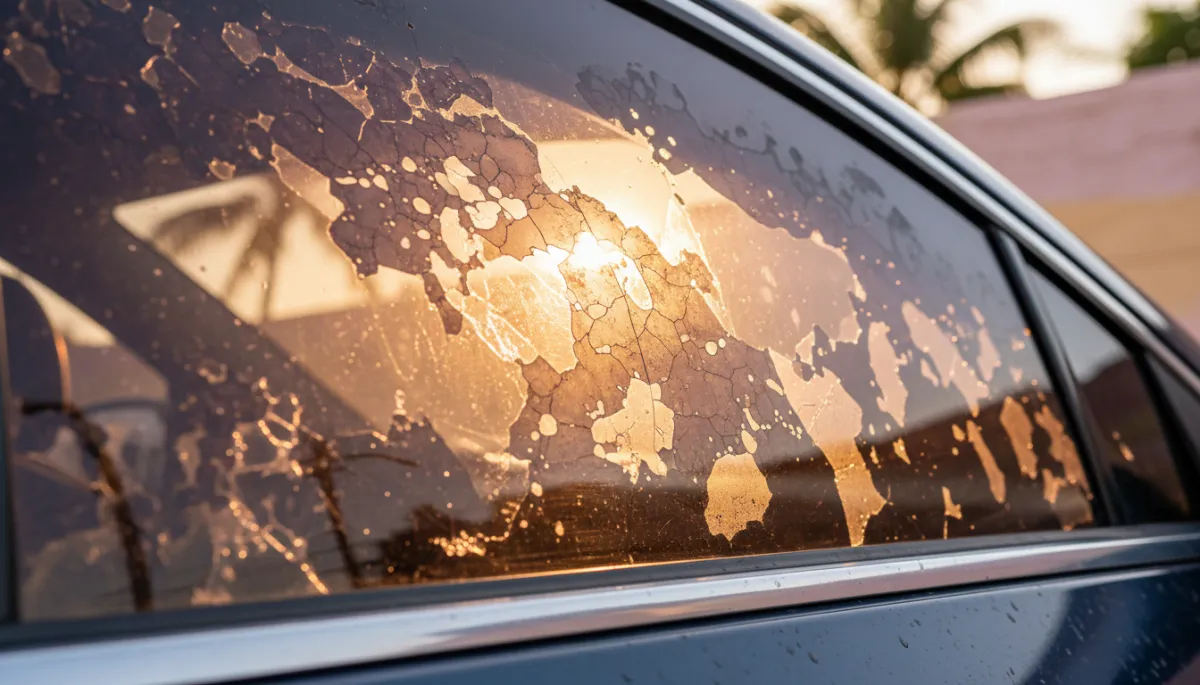
He'd walked out to his car — a 2019 Honda Accord he kept immaculate — and the afternoon sun caught the back window at just the right angle. That's when he saw it. Bubbles. Dozens of them. Small at first, clustered near the corner. And a shade of purple-brown that definitely wasn't there six months ago when he'd paid $80 at that spot on Calle Ocho.
He tried pressing them flat with his thumb. They didn't move. He drove to work, radio off, already doing the math. How long until the whole window looks like that? How long until the cop on Flagler notices and writes him a ticket for tint that's now both illegal and ugly?
Carlos's story is not unusual. Not in Miami-Dade. Not in a county where the heat index hits 105°F in July and the humidity never really quits — not even in January. Drive through Westchester, Doral, or Little Havana long enough, and you'll spot them everywhere: cars with cheap tint peeling at the edges, turning purple, bubbling like a bad sunburn on a forgotten Saturday at the beach.
Here's the thing nobody tells you when you're handed that $80 quote: cheap window tint and Miami's climate are fundamentally incompatible. Not just inconvenient. Chemically, physically, structurally incompatible.
This post is the explanation nobody gave Carlos — and what thousands of Miami-Dade drivers have quietly figured out the hard way.
Why Miami's Humidity Destroys Cheap Tint
Window tint film is, at its core, a multi-layer adhesive product. It needs to bond cleanly to glass, stay bonded through hundreds of thermal expansion and contraction cycles, and block UV and infrared light without breaking down chemically.
Miami makes every single one of those jobs harder.
South Florida's average relative humidity sits between 75% and 90% for most of the year. When you combine that with heat that regularly turns car interiors into 160°F convection ovens, you create conditions that act like a slow chemical attack on the adhesive layer of cheap tint film.
The process looks like this:
- Moisture infiltration. Low-grade film uses adhesives that are not fully moisture-resistant. Humidity creeps in around edges and through micro-pores in the film itself.
- Adhesive breakdown. Once moisture reaches the adhesive layer, it begins to separate from the glass. Heat accelerates this — and in Miami, heat is relentless. That separation is what creates bubbles.
- Dye oxidation. The cheapest tints are dyed films — meaning color is embedded in the material itself, not achieved through metal or ceramic particles. UV light and heat oxidize the dye over time, turning it brown or purple. That's not dirt. That's the film's chemistry failing in real time.
- No recovery. Once cheap tint starts bubbling or turning color, there's no fixing it. It has to come off — and removing bad tint is time-consuming, sometimes damaging to rear defroster grids, and never cheap.
If you're near the Airport Area, Sweetwater, or West Miami and wondering why your neighbor's tint looks pristine while yours is falling apart — this is exactly the answer. Different products. Vastly different outcomes.
The Three Types of Cheap Tint That Fail in South Florida
Not all cheap tint fails the same way. Here's what's lurking behind those discount quotes:
1. Dyed Film
The most common bargain option. No metallic or ceramic particles — just colored polyester. It absorbs heat rather than blocking it, meaning your car actually gets hotter inside. The color fades within months under South Florida UV exposure. Zero real heat rejection. Almost no UV protection. Often the fastest to purple and peel in Miami's unforgiving climate. This is what fills the swap meets and the $59 full-car specials.
2. Low-Grade Carbon Film
A step up from dyed — but not by much when it's manufactured cheaply. Good carbon film can work, but the no-name versions often have inconsistent particle distribution, weak adhesives, and no meaningful warranty. You might get a year before the problems start. In Miami's humidity, usually less. You'll know it's failing when the edges start lifting on hot afternoons.
3. "Ceramic" Imposters
This is the sneaky one — and the most frustrating for educated consumers. Some shops advertise "ceramic tint" at prices that should immediately raise red flags: $99 full car "ceramic" packages, or similar. Real ceramic film is expensive to engineer and manufacture. What these shops are often selling is a dyed or carbon film with a ceramic-sounding marketing label. No ceramic nano-particles. No verified heat rejection numbers. No manufacturer standing behind it. When drivers near Doral or Coral Gables call Best Window Tinting about a competitor quote that sounds too good to be true — this is almost always what's behind it.

What 3M Ceramic Film Does Differently
3M is not cheap. And that's not a flaw — that's the entire point.
3M ceramic nano-technology uses actual ceramic particles embedded throughout the film matrix. This isn't a coating or a label. It's a fundamentally different product with measurably different performance, backed by decades of engineering and real-world data from environments exactly like South Florida.
Here's what that means in practical terms for Miami-Dade drivers:
- Up to 99% UV rejection. 3M ceramic films block up to 99% of the UV rays that fade your dashboard, crack your leather, and hit your skin and your family's skin on every daily commute. In South Florida, that protection matters 365 days a year — there is no off-season.
- Serious heat rejection. 3M's Crystalline and Ceramic IR series reject a substantial portion of infrared heat, meaning your cabin temperature drops measurably — and your A/C doesn't have to work as hard. Real comfort, real fuel efficiency, real difference on the Palmetto in July.
- Signal integrity. Ceramic particles don't interfere with GPS, cell signal, or radio. Unlike metalized films, you won't lose navigation on the way through Doral or approaching MIA.
- Zero color shift. Ceramic film doesn't fade, purple, or discolor. The look on day one is the look in year seven. Neighbors will ask if you just got your car tinted — in year four.
- Backed by 3M's manufacturer warranty. When Best Window Tinting installs 3M film as a certified authorized dealer, that installation is backed by 3M's manufacturer warranty — not just a shop sticker. That's a guarantee you can actually hold someone to.
This is why drivers who make the switch tend to be permanently done with the "cheap tint every eighteen months" cycle. Not because they gave up on the comparison. Because there's nothing left to compare.
Real Miami Drivers Who Made the Switch
Talk to the regulars who make their way to Best Window Tinting at 7284 NW 8th St, just off NW 8th Street near Flagami, and you'll hear the same story told different ways.
A Westchester driver with a 2021 Toyota Camry came in after her third set of bubbling tint in four years. Two different shops, both low quotes, same result. She got 3M Crystalline installed and called back six months later: "My car doesn't feel like an oven anymore." She hasn't been back for a repair — because there's been nothing to repair.
A Sweetwater contractor had his work truck done after the rear windows started delaminating and making noise at highway speed. He needed something that would survive daily use parked in the sun near job sites from Doral to South Miami. That 3M ceramic install is now two years old and looks exactly as it did on day one.
A Little Havana family came in specifically to protect a 2022 Chevrolet Suburban — kids in the back seat every day, leather interior, full South Florida sun. Skin protection from UV wasn't an afterthought. It was the primary reason they walked in. They left with measurably cooler back seats, a cabin that held its leather smell instead of the baked-plastic scent of overheated interior surfaces, and peace of mind that doesn't expire.
With 4.8 stars across 812+ Google reviews, the pattern is consistent across the map — Flagami, West Miami, Coral Gables, Airport Area: real people, real Miami conditions, results that hold. No bubbling complaints. No purple-window follow-ups. No repeat visits for the same problem.
A Quick Note on Florida Tint Laws (2025/2026)
One practical point while we're here — because this comes up more than it should. Florida's current window tint laws require:
- Front side windows: Must allow more than 28% of light in (28% VLT minimum)
- Rear side windows: Must allow more than 15% of light in
- Rear window: Must allow more than 15% of light in
- Windshield: Non-reflective tint allowed on the top 6 inches only
Here's the issue with cheap tint that fades and changes VLT over time: you can start legal and drift into illegal territory without realizing it. That purple-brown film that's shifted color is often darker — and more reflective — than it was on install day. Getting pulled over near Flagler Street or on the Palmetto with out-of-spec tint is an entirely avoidable problem. Best Window Tinting ensures every installation meets Florida law at the time of application, with no guesswork and no surprises at a traffic stop.

Stop the Cycle. Get It Done Right, Once.
The cheap tint math never quite works out. You pay $80. It fails in six months. You pay another $80. It fails again. Two years in, you've spent $160 or more, your windows look terrible, and you're starting over — again. Meanwhile, the driver across the street who invested in 3M ceramic film two years ago still has a pristine install and hasn't thought about their tint once since the day they drove home.
The best window tinting near Flagami, Westchester, Doral, Sweetwater, or anywhere else in Miami-Dade isn't the cheapest quote you can find. It's the installation that's still working three, five, seven years from now — without a follow-up visit, without a peeling edge, without a ticket.
Best Window Tinting & Car Accessories has served Miami-Dade as a certified 3M Authorized Dealer with 812+ five-star Google reviews from drivers across the county. If you're ready to stop gambling on bargain film, give us a call at 786-917-2171 or stop by the shop on NW 8th Street. No mobile tinting — quality work, done right, at our location.
Ready to Ditch the Cheap Tint? Visit Miami's 3M Authorized Experts.
Best Window Tinting & Car Accessories
📍 7284 NW 8th St, Miami, FL 33126
🌐 bestwindowtinting.weebly.com
⭐ 4.8 Stars · 812+ Google Reviews
✅ 3M Authorized Dealer | Ceramic Film Specialists | Commercial & Residential Film Available
❌ No mobile tinting — quality work done right at our shop.
Stop gambling on cheap tint. Come see why hundreds of Miami-Dade drivers trust us with their vehicles every month.
Follow us on Instagram @bestwindowtinting and Facebook Best Window Tinting Miami for before/after shots, tinting tips, and Miami car culture. Leave us a review on Google — it means the world to us: https://share.google/SeejrUMdvt2gHaz2L
