Why Cheap Tint Fails in Miami Humidity (And What Miami Drivers Should Use Instead)
The Mistake That Costs Miami Drivers Twice
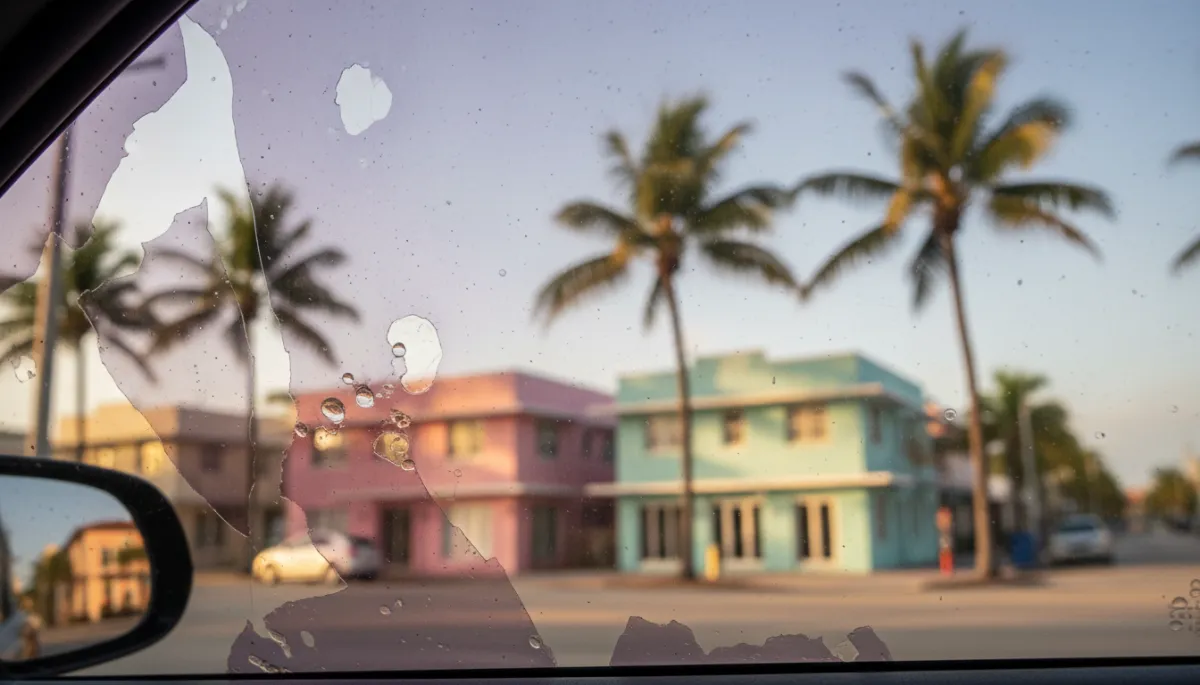
You've seen it on Calle Ocho, parked outside a quinceañera on Flagler, baking in the afternoon sun in a Westchester strip mall lot — a car with window tint that's turned a sickly purple, bubbling up at the corners like blisters on a sunburn. The driver paid a hundred and fifty bucks, maybe two hundred, thought they were getting a deal. A year later, they're back to square one, except now the old film has to come off too.
It's one of the most common and most avoidable mistakes Miami-Dade car owners make. And the frustrating part? The failure wasn't random. It was guaranteed the moment that cheap film went up.
If you live anywhere within five miles of ZIP 33126 — Flagami, Westchester, Sweetwater, West Miami, or right off the MIA corridor — this guide is going to save you real money. We're going to walk through exactly why budget window tint fails in our climate, and what you should be putting on your car instead.
Why Miami's Climate Destroys Budget Window Film
Miami is not Phoenix. Miami is not Las Vegas. The heat here comes with a partner: humidity. South Florida sits at a tropical climate designation — average relative humidity hovering between 75% and 85% year-round, with peak UV index readings that rank among the highest in the continental United States. That combination is brutal on any product that uses an adhesive to bond to glass.
Cheap window tint is held to your car's glass by a pressure-sensitive adhesive — the same basic category of adhesive used on tape. When that adhesive is repeatedly cycled through high heat, high humidity, and rapid cool-down (every time you park in the sun and then blast your AC), it degrades. The bond weakens. Moisture infiltrates the micro-gaps between film and glass. What you get is delamination — bubbles, lift, and eventually full separation of the film from the glass.
Miami doesn't just accelerate this process. Miami treats cheap tint the way saltwater treats cheap iron. It's not a question of if. It's a question of when.
Three Mistakes Miami Car Owners Keep Making
Mistake #1 — Buying Window Tint Based on Price Alone
The most common tint sold at budget shops and quick-service locations is dyed film. Dyed film works by embedding color pigments into the polyester film layer to block light. It's inexpensive to manufacture, easy to install, and looks perfectly fine on day one.
The problem is what happens to those dye pigments in our South Florida sun. UV radiation breaks them down — chemically. The deep charcoal you paid for fades to that unmistakable purple haze within twelve to eighteen months in Miami's climate. At the same time, the low-grade adhesive holding the film to the glass is losing its grip.
What you end up with is film that's simultaneously discolored and delaminating. Bubbles form near the edges first, then spread inward. And here's what nobody tells you at the budget shop: removing failed tint is labor-intensive. Add that cost to what you already paid, and the "deal" becomes one of the most expensive decisions you made for your car.
Drivers in Doral, Sweetwater, and along the MIA airport corridor — areas with longer daily commutes and more time parked in open sun — tend to experience this failure even faster than the Miami average.
Mistake #2 — Going to a Mobile Tinter or No-Name Shop
Miami has no shortage of tinting operations working out of a van, a tent, or a parking lot. They're convenient, they're cheap, and they will almost certainly give you a subpar result.
Professional window tinting requires a climate-controlled environment. Film installation in high humidity creates a nightmare scenario: dust particles and moisture trapped between the film and the glass, visible as tiny bubbles or specks the moment you look through the window at an angle. No amount of squeegee pressure can push them out after the adhesive sets.
A proper tint installation — the kind that lasts — happens indoors, in a clean environment where airborne particles and humidity are controlled. That's not something a parking lot operation can offer. The film they're using is also typically the cheapest dyed product available, because margins are already thin at their price points.
When neighbors from Little Havana or Coral Gables ask us why their tint from a mobile installer looks different on each window — or why it started bubbling within months — the answer is almost always the same: environment and materials.
Mistake #3 — Ignoring UV Rejection Specs
Here's the mistake that surprises people most: cheap tint blocks light. It does not reliably block UV.
Ultraviolet radiation is invisible. A darkly tinted window can block 90% of visible light and still transmit a significant portion of UV rays — because dyed film is engineered for optical density, not UV rejection chemistry. UV is what fades your dashboard. UV is what cracks your leather seats. UV is what breaks down plastics, causes steering wheels to become sticky and discolored, and — importantly — what causes cumulative skin damage during your daily commute on the 836, the Palmetto, or Bird Road.
If your tint doesn't have verified UV rejection specs from the manufacturer — not the installer, the manufacturer — you have no idea what's actually stopping at that glass.

The Right Solution for South Florida Roads
3M Ceramic Series window film is a fundamentally different product from dyed film. Instead of pigments that fade, ceramic film uses nano-ceramic particles suspended in the film matrix. These particles block heat and UV through a physical and chemical interaction with infrared and ultraviolet light — not through color, not through metallic interference, and not through an adhesive system designed for low-stress environments.
What that means for Miami drivers:
- No color shift. Ceramic film stays the same shade it was installed as — no purple fade, no bronze haze. Three years from now, it looks like day one.
- No bubbling. 3M's adhesive systems are engineered for heat and humidity cycling — exactly the conditions Miami imposes daily.
- Real UV blocking. 3M Ceramic Series rejects up to 99% of UV radiation — the number that actually protects your interior and your skin.
- Heat rejection without signal interference. Unlike metalized films, ceramic doesn't interfere with GPS, cell signals, or toll transponders — a real concern for daily commuters on the Palmetto or 836.
3M backs this with a manufacturer's warranty that covers the film itself — not just the installation. That's a commitment budget film manufacturers simply cannot make.
Serving Flagami, Westchester, Doral, Sweetwater, and Beyond
Best Window Tinting & Car Accessories is located at 7284 NW 8th St in Miami — right in the heart of the Flagami district, minutes from Westchester, West Miami, Sweetwater, and the entire MIA airport corridor. Drivers from Doral cut through the Palmetto to get here. Customers from Little Havana are five minutes away. Even folks from the Coral Gables edge and South Miami make the trip — because once you know the difference, you stop looking for the cheapest option and start looking for the right one.
We are a 3M Authorized Dealer. That designation matters: it means we carry authentic 3M product, our installers are trained on 3M's proper application technique, and every installation happens in a professional, climate-controlled environment that protects the film from the moment it goes on the glass. There are no shortcuts here. No parking lot setups. No compromise on materials.
We also handle commercial window film for Miami businesses, residential tinting for condos and homes, and car accessories beyond tint. And we do not offer mobile installation — because doing it right requires doing it in the right environment.

Stop Replacing Cheap Tint Every Year — Visit Best Window Tinting
If your windows have bubbles, a purple haze, or film that's starting to lift at the edges, the time to act is now — before Miami's heat makes the removal messier and the damage to your interior harder to reverse. Every month you wait is another month of UV hitting your leather, your dash, and your skin through glass that was never doing its job properly.
Come see the difference that a 3M Authorized Dealer makes. One appointment. One professional installation. Film that will still look and perform exactly the same three, four, five years from now.
📍 7284 NW 8th St, Miami, FL 33126
📞 786-917-2171
🌐 bestwindowtinting.weebly.com
⭐ 4.8 Stars · 812+ Google Reviews — See why Miami-Dade drivers keep coming back.
✅ 3M Authorized Dealer | Ceramic Film | Commercial & Residential | NO mobile tint — professional shop installation only.
Follow us on Instagram @bestwindowtinting and Facebook Best Window Tinting Miami for before/after shots, tinting tips, and Miami car culture. Leave us a review on Google — it means the world to us: https://share.google/SeejrUMdvt2gHaz2L
