What Miami's Sun Is Doing to Your Car Interior Every Single Day
It’s 2:17 PM on a Thursday in July. You’ve just parked in front of La Carreta on Flagami’s Eighth Street, run your errands, and now you’re back. You reach for the door handle — it’s almost too hot to touch. You slide into the driver’s seat and feel it immediately: the air is thick and burning, your steering wheel is barely touchable, and the seat fabric feels like it’s been sitting under a broiler. You blast the AC and wait.
But here’s what you’re not thinking about in that moment: what is the sun doing to the inside of your car when you’re not looking?
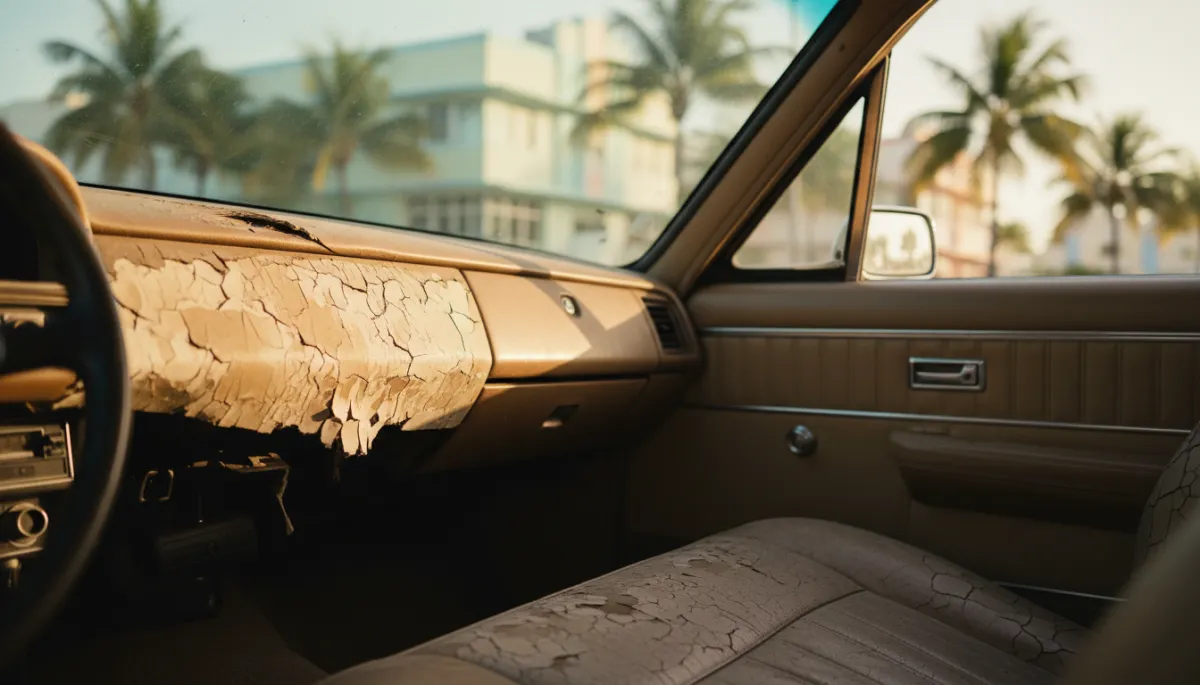
The UV rays that just poured through your windows for the past hour didn’t just make your car uncomfortable. They were quietly at work — breaking down leather fibers, bleaching pigment out of your dashboard, accelerating the micro-cracking of vinyl surfaces. And they’ll do it again tomorrow, and the day after that, with the same relentless precision.
This is the damage most Miami-Dade drivers never see — until it’s already done.

The Mistake Almost Every Driver Makes
There’s a common assumption shared by car owners across South Florida: that their windows are already doing the job. After all, glass blocks the sun, right? You can feel the shade from inside the vehicle.
Here’s what most drivers in Doral, Westchester, and Little Havana don’t realize: standard automotive glass blocks only about 37% of total solar UV radiation. Your windshield performs better — laminated glass blocks most UV-B rays. But your side and rear windows? They’re nearly transparent to UV-A radiation — the wavelength that penetrates deepest into organic and synthetic materials and causes the most significant long-term damage.
Every time you drive down Coral Way, sit in Airport-area traffic on NW 36th Street, or park outside your office in West Miami, UV-A rays stream through those seemingly solid windows — unobstructed — and quietly dismantle your car’s interior. This is the mistake: assuming the glass is doing enough when it’s barely doing anything at all.
What’s Actually Happening to Your Interior
UV radiation is electromagnetic energy. When it contacts organic and synthetic materials — leather, vinyl, plastic, dye molecules — it breaks chemical bonds in a process called photodegradation. In Miami’s climate, this happens faster than almost anywhere else in the continental United States.
We sit at roughly 25.8 degrees latitude. Our UV Index regularly hits 10+ from April through October. Humidity amplifies stress on interior materials. And the heat that builds inside a parked car — easily reaching 140–160°F on a South Florida summer afternoon — accelerates every chemical reaction. The combination is relentless.
Leather and Vinyl Cracking
Natural leather relies on moisture-retaining proteins called collagen fibers. UV radiation breaks these fibers apart. Combined with the heat cycling of a Miami summer — scorching all day, cooled by AC every time you drive — leather contracts and expands repeatedly until it cracks. Premium leather seats that should last 15+ years begin showing cracks in 5–7 years on unprotected vehicles in South Florida. Synthetic vinyl follows the same pattern: brittleness, lost flexibility, and splits at stress points like seat edges and headrests.
Dashboard Fade and Warping
Your dashboard is a composite of ABS plastic, foam, and surface coatings — engineered to hold up for years. UV exposure bleaches the surface dye and breaks down the underlying plastic polymers. The dashboard becomes chalky-looking first, then begins to warp as the foam substrate absorbs heat unevenly. On many vehicles, you’ll see the textured surface develop a sticky, tacky residue as the plasticizers in the vinyl off-gas under heat stress. It doesn’t just look bad — it becomes difficult to clean and impossible to fully restore without professional intervention.
Steering Wheel and Trim Degradation
Your steering wheel is one of the highest-UV-exposure surfaces in your vehicle. Positioned almost directly in the sun’s path when the car is parked facing east or west, it catches reflected UV even in partial shade. Leather steering wheels crack and peel. Urethane wraps bubble. Chrome and piano-black trim pieces fade and micro-scratch more easily once UV breaks down their protective clear coats. In Sweetwater and the neighborhoods along the Airport corridor — where cars sit in open lots all day — steering wheel damage is often visible on vehicles less than three years old.
Why Miami Is the Worst-Case Scenario for Car Interiors
Not all sun is created equal. Miami-Dade County receives an average of 3,154 hours of sunshine per year. Our proximity to the equator means UV rays arrive at a more direct angle than cities further north — less atmosphere to absorb them, more energy delivered per square inch of surface.
Add South Florida’s humidity, and the damage compounds. Moisture acts as a conductor for certain photodegradation reactions in organic materials, accelerating breakdown that might otherwise take years longer in a drier climate.
Then consider the realities of Miami-Dade car ownership: outdoor parking is the norm in Flagami, Little Havana, and Coconut Grove. Garages are scarce, especially near the Airport area and in older Westchester and South Miami neighborhoods. Many residents commute daily on I-836, the Palmetto Expressway, or surface streets where south-facing windows bake for hours at red lights. A car parked outside all day in Doral in July is absorbing UV exposure at a rate that would shock most people who’ve never lived here.
The result: Miami-Dade car owners experience interior UV damage at a rate 2–3 times faster than drivers in northern states. What takes 12 years to show in Chicago happens in 4–5 years here.

How 3M Ceramic Film Changes Everything
This is where the story changes — and it changes dramatically.
3M ceramic window film doesn’t just tint your windows. It fundamentally alters what comes through the glass. Ceramic film works through a non-metallic, nano-ceramic particle matrix that absorbs and reflects solar energy before it enters the vehicle. Unlike basic dyed film — which fades, bubbles, and fails within 3–5 years in Miami’s humidity — or older metalized film that interferes with GPS and phone signals, 3M ceramic film is engineered for the long haul.
For drivers searching for the best window tinting near Doral Miami or the right car tint shop near me Miami, here’s what 3M ceramic film delivers:
- Up to 99% UV rejection — both UV-A and UV-B, the wavelengths that destroy leather, fade dashboards, and crack vinyl
- Up to 60% heat rejection — your interior stays dramatically cooler on a parked South Florida afternoon
- Optical clarity — glare reduction without heavy darkening, maintaining safe visibility at legal tint percentages
- Zero signal interference — no metal in the film means GPS, mobile data, and toll transponders work perfectly
- 3M manufacturer warranty — backed directly by 3M, not just the installer, for genuine long-term protection
That last point matters enormously. Best Window Tinting & Car Accessories is a certified 3M Authorized Dealer — one of a select group of Miami-Dade shops authorized to carry and install 3M film with the full manufacturer warranty behind every application. When you search for 3M ceramic film Westchester or window tinting near Coral Gables, you want a shop that can actually back the warranty on the film it installs. That’s not a universal standard in this industry.
The science matters because in a climate as aggressive as South Florida, cheap film fails fast. Drivers across Coconut Grove and West Miami who’ve tried budget-brand tint know the story: bubbling in year two, purple haze by year three, peeling by year four. You end up paying twice — sometimes more. 3M ceramic film, installed correctly in a professional environment, is a one-time investment that protects your interior for the life of the vehicle.
What Miami Drivers Are Saying
Best Window Tinting & Car Accessories has been protecting Miami-Dade vehicles since before “ceramic film” was a mainstream term. With a 4.8-star rating across 812+ Google reviews — among the highest-rated tint shops in all of South Florida — the results speak for themselves.
The reviews tell a consistent story: drivers from Westchester, South Miami, the Airport area, and Flagami who came in for UV protection window tint Miami-Dade left with cars that finally felt like premium cabins rather than greenhouses. First-time customers returned for their spouse’s car, their SUV, their work truck. The 3M film doesn’t just protect — it transforms the experience of being inside your car during a Miami summer.
And because Best Window Tinting operates as a professional in-shop installation facility only — no mobile tinting, no parking lot setups — every film application happens in a controlled environment free from dust, wind, and humidity fluctuation. The kind of environment that allows a technician to lay film cleanly, without bubbles, without contamination, and with the precision your car genuinely deserves.
Whether you’re in Flagami looking for the best window tinting near Flagami Miami, in Doral comparing options for interior protection window film South Florida, or anywhere across Miami-Dade where the sun shows no mercy — this is the standard of care that makes the difference between a tint job you’re happy with and one you’ll never have to think about again.
Your Next Step
Ready to protect your car’s interior from Miami’s relentless sun?
Best Window Tinting & Car Accessories is Miami-Dade’s trusted 3M Authorized Dealer, serving Flagami, Doral, Westchester, Coral Gables, Little Havana, and surrounding neighborhoods.
📍 7284 NW 8th St, Miami, FL 33126
📞 786-917-2171
🌐 bestwindowtinting.weebly.com
⭐ 4.8 Stars — 812+ Google Reviews
Professional in-shop installation only — no mobile tinting. Because your car deserves a controlled environment, not a parking lot.

Follow us on Instagram @bestwindowtinting and Facebook Best Window Tinting Miami for before/after shots, tinting tips, and Miami car culture. Leave us a review on Google — it means the world to us: https://share.google/SeejrUMdvt2gHaz2L
