What Miami's 4 PM Sun Is Doing to Your Family Inside the Car

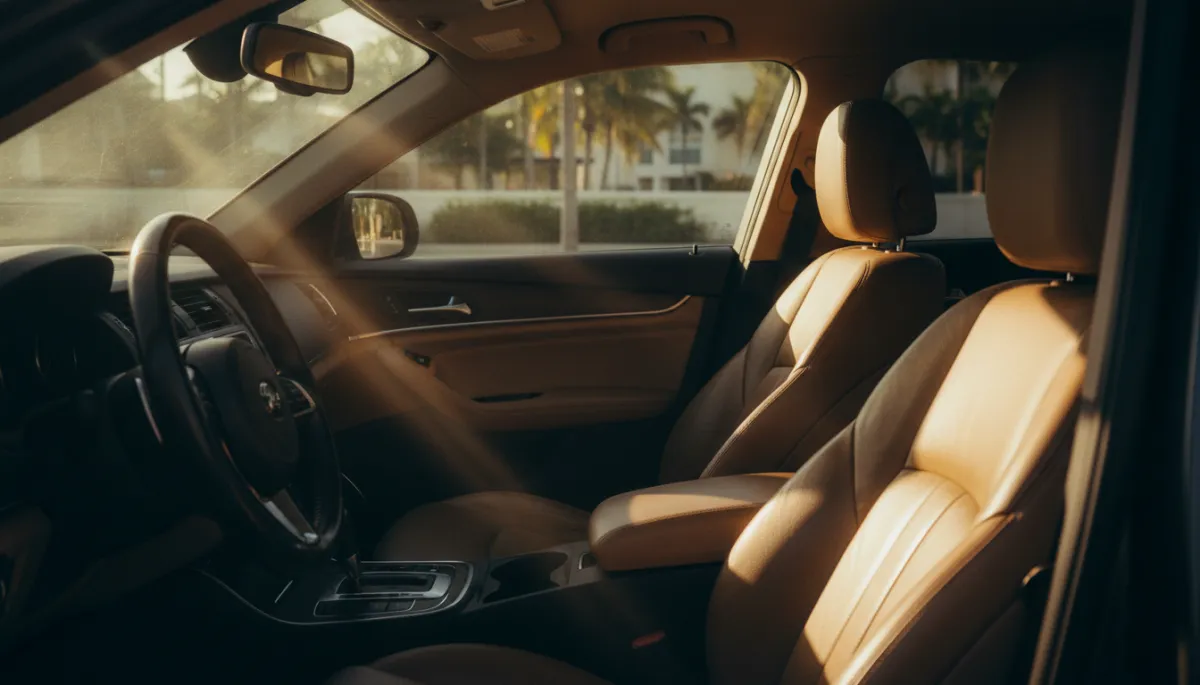
It's Thursday afternoon on NW 8th Street, just past Flagami. The light turns red. You're sitting in traffic, AC running full blast, trying to cool down from the moment you stepped off the sidewalk. Your leather steering wheel is almost too hot to hold. The dashboard looks just a little more faded than you remember it. You reach for your phone at the light and notice the back of your hand — the left one, the one that always rests near the door window on your commute home.
Nothing seems wrong. This is just Miami in July. This is normal.
But something is happening that you cannot see. Ultraviolet radiation — the same radiation responsible for sunburns, premature skin aging, and melanoma — is passing directly through your car's side windows right now. While you idle in traffic on familiar Flagami streets, UV rays are silently working on your skin, your leather seats, your dashboard, and every interior surface in your car. And most Miami-Dade drivers have absolutely no idea.
The UV Reality Most Miami Drivers Don't Know
Here's the myth that millions of drivers carry with them every single day: car windows block UV rays and protect you from the sun.
It's a reasonable belief. You're inside the car. The glass is solid. You're not baking on South Beach — you're in the climate-controlled shade of your vehicle. But this intuition is wrong in a way that has real, measurable consequences for your health and your car's interior condition.
Standard automotive glass does block most UVB rays — the short-wavelength radiation responsible for sunburns. That's why you don't step out of a two-hour commute looking like you spent the afternoon at Crandon Park without sunscreen. But UVA rays — the longer-wavelength radiation that penetrates deep into the skin, accelerates photo-aging, and is strongly linked to skin cancer — pass through standard window glass with almost no resistance.
Research has documented that standard side windows in passenger vehicles block only around 23% of UVA radiation. That means roughly 77% of the UVA radiation hitting your window is reaching you, every day, for every mile of every commute. The windshield — made from laminated glass — offers better protection. But the side windows and rear glass on most vehicles? Essentially transparent to the UV that matters most.
For families commuting daily through Westchester, the Airport corridor, Doral, and Coral Gables, this is not a one-time exposure. It's cumulative, daily, years-long radiation contact — and the effects build up quietly until they are impossible to ignore.
What Miami's Sun Is Doing to Your Car's Interior
The damage is not limited to your skin. Everything inside your car is taking the same hit — and Miami's climate makes the problem worse than almost anywhere else in the country.
The combination of intense UV radiation, extreme heat (interior temperatures in parked Miami cars regularly reach 160°F to 170°F on exposed surfaces), and persistent humidity creates conditions that degrade automotive materials faster than most drivers realize. Here is what is happening, piece by piece:

Leather seats crack and fade. UV radiation breaks down the collagen structure in genuine leather and the polymer bonds in vinyl at the molecular level. The process is gradual — subtle fading first, then surface stiffness, then visible cracking. Seats that should remain supple for 150,000 miles start showing wear by 60,000 in South Florida conditions.
Dashboards warp and oxidize. The plastics and composites used in modern dashboards are photosensitive. Direct UV exposure causes oxidation — that chalky, bleached, slightly warped surface you see on older Miami cars. Once a dashboard reaches this stage, the damage cannot be reversed without refinishing or replacement.
Steering wheels degrade. Whether leather-wrapped or polyurethane, steering wheels exposed to Miami's daily UV and heat develop a tacky, sticky texture before eventually cracking at high-contact points. In a climate where your steering wheel may reach 130°F on a parked afternoon, this process accelerates significantly.
Upholstery fades unevenly. Fabric seats, headliners, and door panel inserts fade under sustained UV exposure. Drivers commuting westward through Sweetwater and West Miami in the afternoon absorb particularly intense late-day UV on the driver's door side — and the asymmetric fading pattern shows clearly over time.
Trim pieces and electronics suffer. The adhesive bonds holding interior trim degrade under heat. Rubber seals harden and crack. Infotainment screen brightness diminishes over years of heat exposure. None of this is inevitable — but untreated windows make all of it the default outcome for Miami-Dade vehicles.
The Left Side That Tells the Whole Story
There is a documented dermatological phenomenon called "driver's side photo-aging" — disproportionate UV-related skin damage on the left arm, left hand, and left side of the face. Dermatologists have noted that frequent drivers develop more pronounced UV damage on their left side, consistent with decades of exposure through unprotected driver's windows.
For Miami-Dade residents commuting daily through Little Havana, Coral Gables, South Miami, and Coconut Grove — sometimes clocking an hour or more in the car each day — this accumulates faster than most people expect. The parents doing school pickups in Westchester. The professionals on the 836 corridor to the Airport area. The families running weekend errands through Flagami. Every one of them is accumulating UV exposure they believe they're avoiding simply by being inside the car.
The good news: the solution is permanent, one-time, and costs far less than the damage it prevents.
The Effortless Solution: 3M Ceramic Film at Best Window Tinting
Professional window tinting — specifically 3M Ceramic Film from an authorized installer — eliminates this problem completely. Not partially. Not seasonally. Permanently.
3M Ceramic Film blocks up to 99% of UV radiation — both UVA and UVB — through every window it covers. The ceramic technology also rejects significant infrared heat, meaning your cabin stays measurably cooler, your AC operates more efficiently, and your interior surfaces are no longer baking under accumulated solar energy. The film maintains excellent optical clarity: you won't feel like you're looking through darkened glass on an evening commute down Coral Way or US-1, and your nighttime visibility is not compromised.
This is not the cheap, tinted plastic film that bubbles in Miami's humidity after 12 to 18 months. 3M Ceramic Film is engineered specifically for climates like South Florida's. It is backed by a manufacturer's warranty that covers the installation for its lifetime. And at Best Window Tinting & Car Accessories on NW 8th Street, every job is completed inside their professional shop — never mobile, never in a parking lot, never in outdoor conditions that compromise the adhesion or optical quality of the film.
Their 3M Authorized Dealer status is not a marketing detail. It means the film is genuine, the installation follows 3M's certification standards, and the warranty is real and honored. Drivers who have had cheap film applied elsewhere — film that purpled, bubbled, or delaminated within a year of Miami's heat and humidity — understand immediately why this distinction matters when searching for the best window tinting near Flagami Miami or a car tint shop near me Miami.
Families from Doral, Sweetwater, and West Miami make the drive to their 33126 shop because word-of-mouth follows results. Professionals in Coral Gables and South Miami choose them for high-end vehicles because they want 3M Ceramic film installed in a controlled environment by experienced hands — not a rushed mobile job. Residents throughout the Airport corridor find them conveniently located on NW 8th St — minutes from MIA and central to all of Miami-Dade. If you've been searching for 3M ceramic film Doral Miami or the best tint shop near Miami Airport, this is where those searches end.
One Appointment. Years of Protection.
Window tinting is a single appointment. You bring your car in, and you leave with 99% UV protection on every window — protection that your car's standard glass was never designed to provide.
The leather stays supple. The dashboard holds its color and texture. The steering wheel does not crack. Your car's interior retains its condition, which matters significantly in the South Florida used car market where buyers and dealers scrutinize interior quality closely. And every person who rides in your vehicle — every drive through Flagami, every school pickup in Westchester, every Sunday errand through Coconut Grove — does so with meaningful protection from the UV radiation that has been quietly reaching them for years.
One visit. One decision. Best Window Tinting & Car Accessories has 812+ Google reviews at 4.8 stars. Miami-Dade has voted with its cars. It's your turn.
📍 Protect Your Family From Miami's Relentless Sun
Visit Best Window Tinting & Car Accessories — Miami-Dade's trusted 3M Authorized Dealer for ceramic film, commercial window film, and residential window solutions.
📍 7284 NW 8th St, Miami, FL 33126
📞 +1 786-917-2171
🌐 bestwindowtinting.weebly.com
⭐ 4.8 Stars · 812+ Google Reviews
Proudly serving Flagami, Westchester, Doral, Sweetwater, Little Havana, West Miami, Airport area, Coral Gables, Coconut Grove, South Miami, and all of Miami-Dade County.
All installations completed at our professional shop — we do not offer mobile tinting.
Follow us on Instagram @bestwindowtinting and Facebook Best Window Tinting Miami for before/after shots, tinting tips, and Miami car culture. Leave us a review on Google — it means the world to us: https://share.google/SeejrUMdvt2gHaz2L
