
Two Miami drivers. Same neighborhood. Same blazing South Florida summer. One made a quiet decision in June. The other said, “Maybe next month.” Six months later, their cars — and their wallets — tell two completely different stories.
Marco and Carlos: A Miami Tale of Two Cars
Marco drives a 2022 Honda Accord. He parks outside every single day near Miami International Airport, where he works in logistics. Back in June, after sweating through his shirt on the commute one too many mornings, he drove over to Best Window Tinting & Car Accessories in Miami-Dade at 7284 NW 8th St in Flagami and had 3M Ceramic Series film installed on every window. It took a few hours. He drove away in a noticeably cooler car.
Carlos drives a nearly identical car. Parks outside just as much. Lives a few blocks away in Little Havana. He thought about tinting — saw the shop on NW 8th Street, heard his coworker Marco rave about it — but figured it wasn’t urgent. Maybe he’d get to it in the fall. Or next spring. Or whenever the timing felt right.
It’s now late summer. The timing never felt right. And the difference between their two cars is very visible.
The Car That Aged Two Years in One Summer
The Miami sun doesn’t negotiate. South Florida regularly posts a UV index of 11 or higher during summer — the EPA’s “extreme” category. That means the UV radiation hammering the interior of a car parked anywhere in Westchester or Doral on a typical Tuesday is doing real, measurable, cumulative damage to every unprotected surface inside.
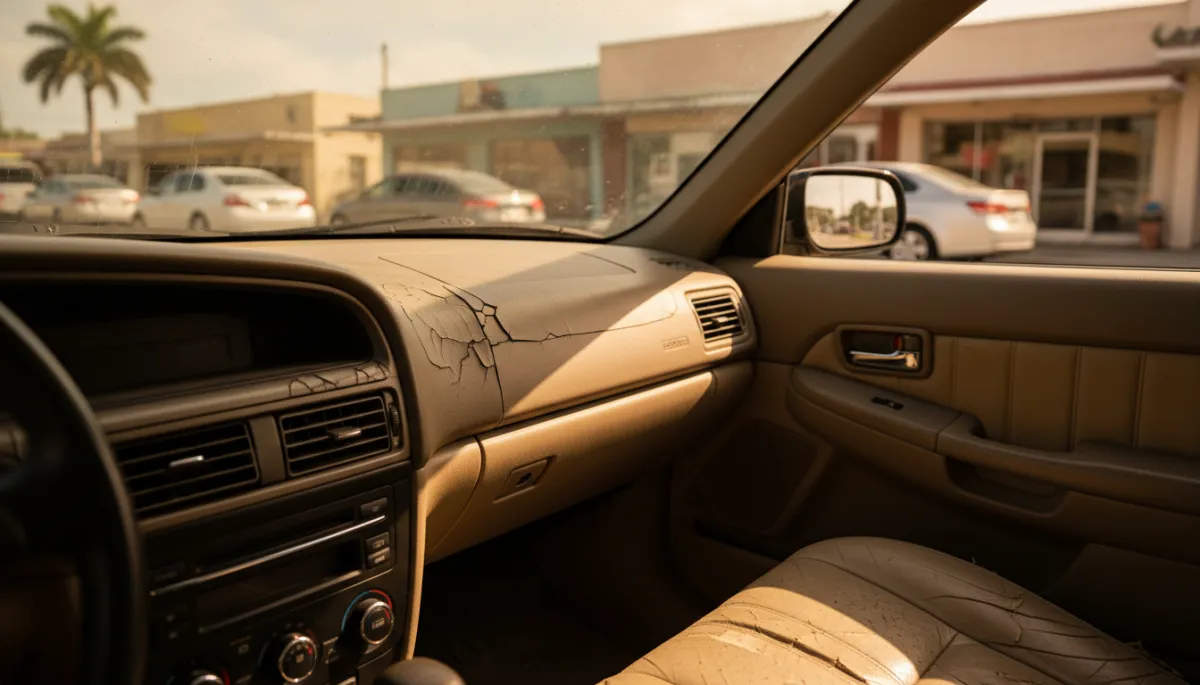
Carlos’s dashboard has already developed a surface crack near the center console — that wasn’t there in April. His driver’s seat, a dark synthetic leather, has begun to fade along the headrest and dry along the bolster. The rear seat, where his kids sit during school runs, has a bleached strip running along the top edge where afternoon sun hits it every single day. None of this happened overnight. It happened one afternoon at a time, silently, invisibly.
Marco’s interior looks barely driven. The dashboard is smooth and unblemished. The seats are deep, even-colored, and supple. Open both car doors side by side and you’ll know immediately which one spent six months in Miami under protection and which one was left to the sun.
Here’s the chemistry: standard automotive glass blocks UVB rays but allows roughly 63% of UVA radiation to pass straight through. UVA penetrates deeper into materials — and skin — degrades them faster, and is the primary driver of the sun damage you see in faded interiors and aged complexions. 3M Ceramic Series film blocks up to 99.9% of both UVA and UVB rays — it’s not a filter, it’s a barrier. That’s what separates a car that holds its value from one that visibly deteriorates.
The AC Bill Nobody’s Talking About
Most Miami drivers never do this calculation: how much extra fuel and mechanical wear does an unprotected, greenhouse-hot car cabin cost every year?
Carlos’s car, parked in the sun in Sweetwater on a July afternoon, can reach interior temperatures of 140°F or higher in under 30 minutes. He gets in, cranks the AC to maximum, and waits 8–12 full minutes before the cabin is tolerable. The compressor runs at full load. Fuel consumption spikes. Belt and refrigerant wear accelerates. And this happens every single workday.
Marco’s car tells a different story. 3M Ceramic film blocks up to 97% of infrared solar heat — the radiant heat that pours through glass like an oven element. His cabin peaks significantly cooler. He gets in, sets the climate control to 72°F, and the car catches up in under four minutes. His AC doesn’t fight the sun; it just maintains comfort. The compressor, the belts, the refrigerant — all under dramatically less strain, all lasting meaningfully longer.
Multiply this across five workdays a week, fifty weeks a year, and the difference in fuel consumption and mechanical wear accumulates into a real number. In a city where people drive as relentlessly as they do across Miami-Dade County, window film is as legitimate a maintenance investment as an oil change or fresh tires — it just doesn’t come with a dashboard reminder.

Skin, UV, and the South Florida Reality
Florida has one of the highest melanoma diagnosis rates in the United States. Miami drivers spend an average of 30 or more minutes behind the wheel each day — adding up to over 180 hours per year of potential unfiltered UVA exposure to the hands, forearms, and the left side of the face and neck.
Dermatologists have a name for what happens over time: “left-arm syndrome.” It’s a documented pattern where drivers show significantly accelerated sun damage on the arm and side closest to the window — more freckling, earlier age spots, a subtly different skin texture on the left hand compared to the right. It’s so consistently observed it has its own informal name in dermatology circles.
Carlos hasn’t connected the dots yet. But the beginning of it is quietly there — a faint sun spot on his left forearm, slightly more freckling on the back of his left hand than his right. Small changes that accumulate over years, not days.
Marco barely thinks about it anymore. That low-level burning sensation on his left arm during long drives through Coral Gables and South Miami for client meetings? Gone. The afternoon fatigue he used to feel after sun-baked commutes? Significantly reduced. The 3M film on his windows isn’t just protecting his car. It’s protecting him.
For families — parents driving children to school in Doral, running errands along Calle Ocho with a toddler in the back, picking up teenagers from soccer practice in West Miami — this matters more, not less. Young skin is more vulnerable to cumulative UV damage. Ceramic window film that blocks 99%+ of UV radiation is one of the simplest, most passive ways to reduce daily UV exposure for everyone in the vehicle, every day.
Resale Value: The Number Buyers Notice First
Picture both men selling their cars in two years. Marco’s interior is pristine — unblemished dash, deeply-colored leather, no sun damage anywhere. He lists it at market value. The first buyer who sits inside says, “Nice condition,” and means it. The deal moves quickly.
Carlos lists his car at the same market value. The first buyer opens the door, sees the cracked dash, the faded bolsters, the bleached strip on the rear shelf. They offer $1,400 below asking and say, “Take it or leave it.” Carlos takes it. He leaves with less money than he should have — the long-term price of a decision he didn’t make six months ago.
Used-car buyers form their judgment in seconds. A clean interior says: someone cared for this vehicle. A UV-weathered interior signals deferred maintenance — and costs you in negotiating power and final sale price. Professional ceramic window film is a single investment that passively protects interior condition for the full life of your vehicle and returns value when it’s time to move on.
Why 3M. Why NW 8th Street.
Not all tint is the same product. Cheap dyed film bubbles and fades within a Miami summer. Metallic film blocks some heat but interferes with GPS, Bluetooth, and phone signals. Genuine 3M Ceramic Series film uses advanced nano-ceramic technology to block infrared heat and UV without metal, without signal interference, and without the purple haze that makes budget tints look worn out within a year.
But even the best film is only as good as the installation. Best Window Tinting & Car Accessories in Miami-Dade is an official 3M Authorized Dealer — meaning the film is authentic 3M product backed by a manufacturer’s warranty, installed by technicians trained to 3M’s standards. No mobile tinting — all work is done in a professional, climate-controlled shop at 7284 NW 8th St, Miami, FL 33126, where dust, humidity, and light are managed for a clean, bubble-free result.
They serve the full Miami-Dade area: Flagami, Little Havana, Westchester, Doral, Sweetwater, West Miami, Coral Gables, South Miami, and all communities near Miami International Airport. Over 812 Google reviews at 4.8 stars — built one car and one satisfied customer at a time. Read the reviews here.

Carlos Called. Finally.
Six months after Marco, Carlos booked an appointment. He’d ridden in Marco’s car a dozen times and felt the difference every time — the quieter cabin, the cooler air, the way his eyes didn’t strain on the highway. He’d gotten into his own car on a sweltering Tuesday and thought: enough.
He called +1 786-917-2171, came in that weekend, and left with 3M Ceramic Series film on every window.
The crack in his dashboard is still there — that’s not going anywhere. The fading on the seat is real and permanent. But from the moment the film went on, the damage stopped accumulating. His AC catches up in under four minutes now. His kids aren’t in direct, unfiltered sun on the morning school run. His resale position stopped deteriorating the day he walked out of that shop.
The best time to tint was six months ago. The second-best time is right now.
If you’re in Flagami, Little Havana, Westchester, Doral, Sweetwater, Coral Gables, South Miami, or near Miami International Airport — and you’ve been putting off window tinting — the sun is already making the decision for you. Every day without ceramic film is another afternoon of cracking, fading, UV accumulation, and AC strain you’re paying for without knowing it.
Don’t be Carlos. Be Marco.
Stop Losing Money to the Miami Sun
Best Window Tinting & Car Accessories in Miami-Dade
3M Authorized Dealer · Ceramic Film · Commercial & Residential · No Mobile Tinting
📍 Visit us: 7284 NW 8th St, Miami, FL 33126
📞 Call or text: +1 786-917-2171
🌐 Website: bestwindowtinting.weebly.com
⭐ 4.8 Stars · 812+ Reviews: Read what Miami says about us
Follow us on Instagram @bestwindowtinting and Facebook Best Window Tinting Miami for before/after shots, tinting tips, and Miami car culture. Leave us a review on Google — it means the world to us: https://share.google/SeejrUMdvt2gHaz2L
