Miami's Sun Is Quietly Destroying Your Car Interior — What Most Drivers Never Know

It's 9:07 in the morning. You're rolling west on Calle Ocho, windows up, AC already fighting back against a July that started too early. The sun is barely above the rooftops of Flagami — and it's already hitting your dashboard at a hard angle, turning that center console into something you don't want to touch.
You probably don't think much about it. Most Miami drivers don't.
That's the mistake.
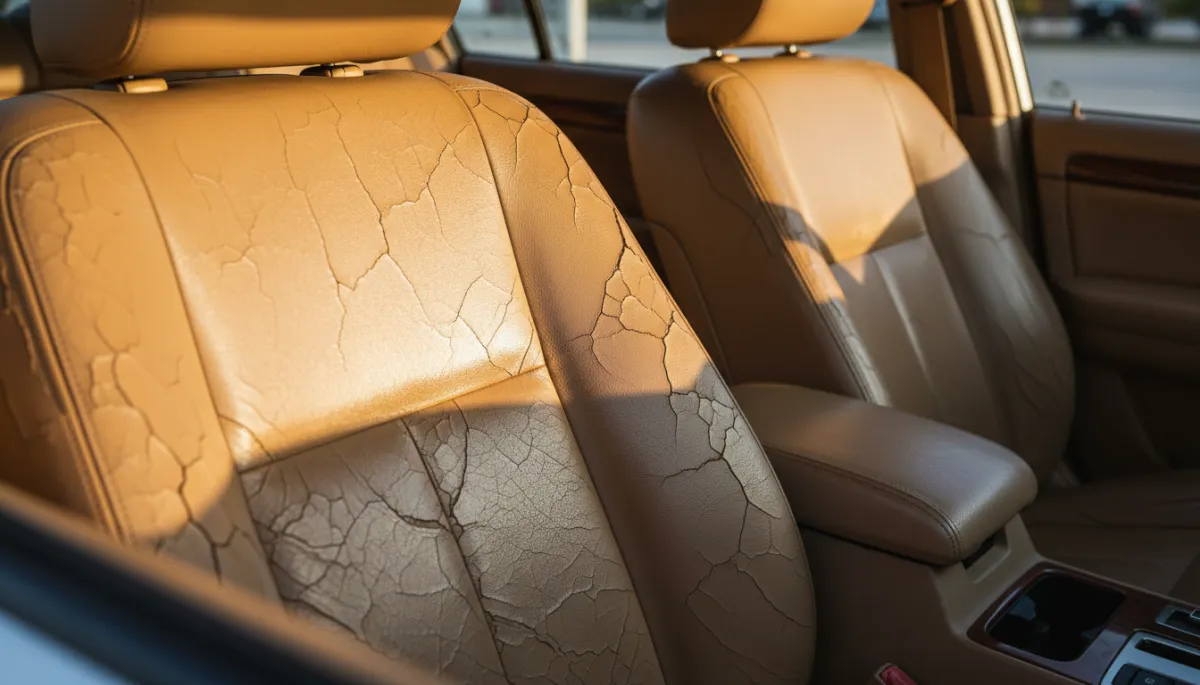
Not a dramatic one. Not the kind that announces itself with a warning light or a repair bill. The UV damage happening inside your car right now is the slow, quiet kind — the kind you won't notice until your leather starts flaking at the creases, your dashboard looks chalky and gray, and your steering wheel's finish has worn through to bare plastic. By then, the damage is done.
What nobody tells you is that you don't have to be driving for this to happen. Every hour your car sits in an uncovered parking lot near MIA, on the street in Westchester, or baking in an open spot off Coral Way, those rays are working on your interior — without you even being there.
UV-A vs. UV-B: The Two Rays Your Interior Hates
Most people think of UV damage the way they think of a sunburn — something that only happens when you're directly in the sun for a while. But there are two distinct types of ultraviolet radiation at play, and they affect your car interior in very different ways.
UV-A rays make up about 95% of the UV radiation that reaches Earth's surface. They penetrate glass — right through it, including your factory windshield and side windows, unless you have protective film. UV-A rays are the primary driver of fading and discoloration. They break down the dyes and pigments in your leather seats, your fabric headliner, and your dashboard trim. This is what turns a rich charcoal interior into something that looks vaguely gray and tired within a few years.
UV-B rays are more intense and carry more energy. They're responsible for structural degradation — the cracking of vinyl, the brittleness of dashboard plastic, the flaking and peeling of leather that wasn't protected. UV-B breaks down polymers at the molecular level.
In Miami, you're getting both, every single day. The Greater Miami area logs over 300 UV-exposure days per year. That's not 300 days of sunshine — that's 300 days where UV intensity is high enough to cause measurable material degradation. To put it plainly: South Florida is one of the most UV-aggressive environments on the continental United States for anything that sits in the sun.
The Miami Multiplier: Heat + Humidity + UV
Here's what makes this worse than a dry desert climate: Miami's humidity.
Dry heat and UV damage is bad. But when you add South Florida's 70–90% summer humidity, you create an environment where materials expand and contract constantly with thermal cycling — while simultaneously being chemically degraded by UV. Leather that might last 10 years in a dry environment may show significant wear in 4–5 years in Miami without protection.
Dashboard plastic cracks differently in humid environments too. Trapped moisture beneath the surface, combined with UV-induced polymer breakdown on top, creates a two-front attack. You see it all the time on unprotected cars that have spent their whole lives here — spider-web cracking across the top of the dash, bubbling in factory vinyl, leather seams that separate at the stitching.
If you live in Sweetwater, Doral, or anywhere near the airport corridor, your car is spending significant time in open commercial lots — no shade structures, no tree cover, maximum exposure. Same story for residents of West Miami and the busier commercial stretches of Westchester, where shaded parking is rare and the midday sun is relentless.

Why Your Tint Might Not Be Protecting You
Here's where a lot of Miami drivers think they're covered — when they're actually not.
If you have older window tint, or had work done at a mobile operation or a discount shop, there's a good chance you have dyed film. Dyed film does some things: it reduces glare, darkens your windows, gives you some privacy. What it doesn't do effectively is block UV at the level your interior actually needs.
Dyed film also fades. The same Miami sun that's degrading your interior is breaking down the tint itself. That purple-ish, hazy look you see on older cars around Little Havana and Coconut Grove? That's dyed film that has lost its color stability. It's not just an eyesore — it means the UV protection that was barely there is now even less.
Metalized film was an improvement, but brings its own tradeoffs: interference with GPS, cell service, and Sunpass transponders. In a city you navigate by phone, that's a real-world problem most drivers don't want.
Neither option gives you what South Florida actually demands.
3M Ceramic Film: Built for Exactly This Climate
This is where the conversation shifts from damage to protection that actually works.
Ceramic window film — specifically 3M's ceramic series — blocks up to 99% of UV radiation, both UV-A and UV-B, without relying on dyes that fade or metals that interfere with signals. The technology uses ceramic nanoparticles embedded in the film matrix: stable, non-fading, and maintaining their UV-rejection properties for the life of the film.
What that means for your interior:
- Leather seats stop fading and drying out from UV exposure
- Your dashboard maintains its original color and flexibility
- Your steering wheel retains its finish and grip texture
- Interior temperatures drop noticeably — reducing AC load and making those first brutal minutes after parking significantly more bearable
- Glare reduction for those blinding westbound drives down Flagler or NW 8th Street during late afternoon, when the sun hits the windshield at exactly the wrong angle
3M ceramic film also rejects significant infrared heat — the kind you feel radiating through glass even on an overcast day. Heat rejection combined with UV blocking is the combination your interior needs in South Florida. Not one or the other.
What's at Stake at Resale
Here's the number that tends to change minds: resale value.
A pristine interior on a Miami-registered vehicle is genuinely uncommon. Dealers know it. Private buyers know it. When you go to sell or trade in a car that's spent three or four South Florida summers without interior protection, the wear shows — and it's factored into the offer. Cracked dashboards, faded leather, and brittle trim panels aren't cosmetic details to a buyer; they're a reconditioning line item.
Contrast that with a car protected from day one with 3M ceramic film: the leather stays supple, the dash stays dark and consistent, and the interior presents like it has far fewer miles than it actually has. That difference at trade-in often exceeds the original cost of the film.
A word on partial solutions: dashboard covers, steering wheel wraps, and windshield sun shades slow the damage but don't stop it. UV still penetrates through side and rear windows. A sun shade only covers the front windshield's footprint. Ceramic film on all glass is the complete answer — and the only one that doesn't require you to remember to use it every single day.
The Neighborhoods That Feel This Most
For residents of Flagami, Little Havana, and West Miami — right on the NW 8th Street corridor — the combination of dense street parking, limited tree shade in commercial zones, and relentless summer sun makes interior protection not optional, but essential. Searching for the best window tinting near Flagami Miami or a trusted car tint shop near me? You're closer than you think.
Drivers commuting through the Airport area and parking in Doral or Sweetwater face similar realities: large surface parking lots, open sky, and a sun that doesn't care about your leather package. Residents of Westchester looking for 3M ceramic film near Westchester Miami will find the shop is just minutes away.
Even in Coral Gables and Coconut Grove, where tree canopy offers shade on residential streets, UV exposure during the daily commute and in commercial parking remains significant. Tree shade blocks visible light — not the UV spectrum.
The answer isn't to avoid the sun. It's to treat your glass the same way you'd treat your skin before a day outdoors. One investment. Lasting protection.
Ready to Protect Your Car's Interior Before the Damage Is Done?
Visit Best Window Tinting & Car Accessories at 7284 NW 8th St, Miami, FL 33126 — right in the heart of Miami, minutes from Flagami, Little Havana, and Westchester.
📞 Call or text us: 786-917-2171
🌐 bestwindowtinting.weebly.com
⭐ 4.8 stars · 812+ Google Reviews — see what your neighbors are saying.
As a certified 3M Authorized Dealer, we offer ceramic film, commercial, and residential window film. We do not offer mobile tinting — every installation is done right, in our shop, the way it should be.
Follow us on Instagram @bestwindowtinting and Facebook Best Window Tinting Miami for before/after shots, tinting tips, and Miami car culture. Leave us a review on Google — it means the world to us: https://share.google/SeejrUMdvt2gHaz2L
