What Miami Sun Really Does to Your Car Interior — And How to Stop It
Two Miami Cars. Two Very Different Stories.
Carlos drives a 2021 Toyota Camry. So does Miguel. They live five minutes apart — both near the Flagami neighborhood, just off NW 8th Street. Both park outside. Both commute on the Dolphin Expressway. Two years ago, Carlos spent an afternoon at Best Window Tinting on NW 8th St and had 3M ceramic film installed on every window. Miguel skipped it. "I'll do it later," he told himself.
Last month, both of them tried to sell their cars.
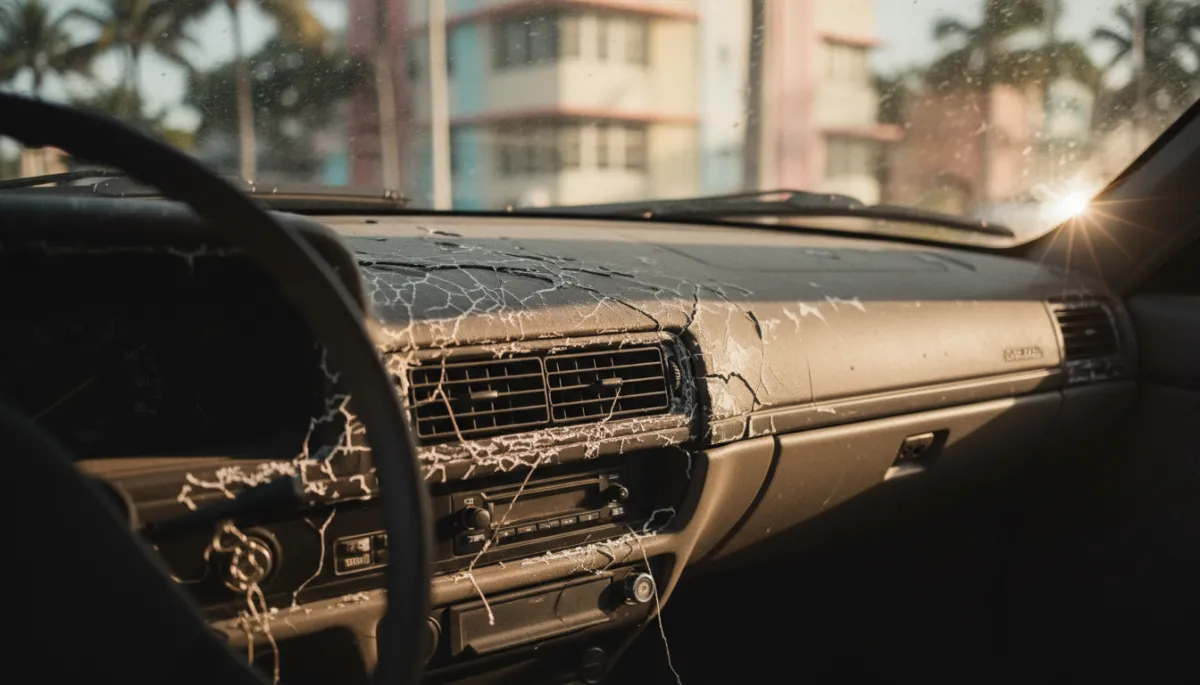
Carlos's Camry looked the way it did when he drove it off the lot. The leather seats were supple and dark. The dashboard was matte and crack-free. The steering wheel still had its grip intact. The appraiser barely blinked. Miguel's Camry told a different story. His dash had a hairline crack running from the center console toward the passenger side. The leather on the driver's seat had faded from charcoal to a washed-out gray. The steering wheel was peeling at the 10 and 2 positions. The appraiser knocked $1,400 off his offer before Miguel could say a word.
The only difference between these two cars was window tint. Specifically, 3M ceramic window film. What happened to Miguel's Camry didn't happen overnight — it happened every single day, for 730 consecutive days, inside a car sitting under the Miami sun.

Miami Is Not a Normal Climate
This is not a minor regional quirk. Miami-Dade County ranks among the highest UV index cities in the United States — consistently hitting UV index 10 and 11 on clear summer days, classified as "Very High" to "Extreme" by the National Weather Service. But UV index only tells part of the story.
South Florida receives over 3,000 hours of sunshine per year — more than Los Angeles, more than Phoenix, more than almost any major American metro. During peak summer months, the sun angle is near-vertical, meaning UV rays hit windshields and side windows at their most punishing angle. And when your car sits in a parking lot in Westchester, Coral Gables, or near Miami International Airport, the interior temperature can climb to 160–180°F — even on an 85-degree afternoon.
The result is a slow-motion destruction of everything inside your vehicle. Most Miami drivers don't realize it's happening until the damage is already irreversible.
What's Actually Happening Inside Your Car
UV radiation attacks your car's interior in two distinct ways. UV-B rays — the kind that cause sunburn — are partially blocked by standard auto glass. But UV-A rays, which make up roughly 95% of ultraviolet radiation reaching Earth's surface, pass through factory glass with almost no resistance. They break down molecular bonds in leather, vinyl, plastic, and fabric at the microscopic level. Every single day. Every single parking spot.
Here's what that damage timeline looks like inside a Miami car with no quality window film:
0–6 months: Subtle color shift in dashboard plastics. Leather begins to lose its natural oils. UV-absorbing dyes in seat fabric start to break down. Most owners notice nothing yet.
6–12 months: Steering wheel begins to lose surface texture at high-contact points. Dashboard develops a slightly chalky, dull appearance. Light-colored leather fades noticeably. The A/C struggles to cool a cabin baking under direct infrared load.
1–2 years: Hairline cracks appear in the dashboard. Leather splits at stress points — seat creases, edges, corners. Door panel inserts lose their original color. The interior no longer looks or feels new. This is exactly where Miguel's Camry arrived after two years of unprotected Miami sun.
3–5 years: Dashboard cracking becomes structural and unsightly. Leather reconditioning at a Miami detail shop runs $400–$800 with no guarantee of full restoration. A steering wheel rewrap costs another $200–$400. By the time you sell, appraisers see it instantly — and price accordingly.
Every dollar of that damage is preventable.
Why Your Windows Are Failing You
Here's what most Miami car owners don't realize: the glass in your vehicle is doing almost nothing to protect your interior from the damage that matters most.
Standard automotive glass does block UV-B rays — the same rays responsible for sunburns on your skin. This is why most drivers don't get visibly burned sitting in their car on a long drive. But UV-A rays and infrared heat energy pass through untreated auto glass with very little resistance. Factory "privacy glass" on rear windows creates the illusion of protection — it reduces visible light but provides minimal UV-A blocking or meaningful heat rejection.
This is the protection gap that professional ceramic window film is specifically engineered to close. But not all film is created equal — and in Miami, the difference between cheap film and quality ceramic is the difference between Miguel's car and Carlos's.
The 3M Ceramic Difference
There are three main categories of window film installed in Miami: dyed film, metalized film, and ceramic film. Understanding the difference is worth two minutes — because the wrong choice can cost you years of protection.
Dyed film is the cheapest option on the market. It reduces visible light but does almost nothing for heat rejection or meaningful UV blocking. It typically fades within 12–18 months in Miami's climate. You'll recognize it as the purple-tinted, bubbling film peeling off older used cars in parking lots across Sweetwater and West Miami.
Metalized film performs better — it reflects heat using metallic particles embedded in the film. The drawback? Those same particles interfere with GPS signals, cell reception, and satellite radio. It's also prone to delaminating in high-humidity environments like South Florida.
3M Ceramic film uses nano-ceramic technology with no metal and no dye. It blocks up to 99% of UV rays — both UV-A and UV-B — and rejects up to 60% or more of solar heat energy. It causes zero signal interference. It doesn't fade, bubble, or turn purple. And it's backed by a 3M warranty that covers the film for the life of your vehicle.
As a 3M Authorized Dealer, Best Window Tinting installs genuine 3M ceramic film to manufacturer standards. That authorization isn't a marketing claim — it means the warranty is valid and the installation meets 3M's own quality requirements.

Which Miami Neighborhoods Should Pay Attention?
If you live or work within a few miles of zip code 33126, UV exposure risk is high and parking is typically unsheltered. Here's who this affects most — and what's at stake.
Coral Gables drivers tend to own higher-value vehicles where interior condition is directly tied to resale price. A cracked dashboard or faded leather on a BMW or Mercedes in Coral Gables isn't just cosmetic — it's thousands in depreciation. If you're searching for best window tinting near Coral Gables Miami, Best Window Tinting is minutes away on NW 8th St.
Coconut Grove car owners face a specific challenge: outdoor parking near the bay, long sun exposures along South Bayshore Drive, and the intensity of UV light reflected off Biscayne Bay. For 3M ceramic film near Coconut Grove, the closest professional shop is right here in the Flagami area.
In Westchester and West Miami, family SUVs and trucks dominate the roads. Larger vehicles mean more glass surface exposed — and more interior at risk. Parents, coaches heading to Tropical Park, and commuters cutting through to the Palmetto all benefit from professional window tinting near Westchester Miami.
South Miami, Flagami, and the Airport area bring daily commuters, rideshare drivers, and professionals whose vehicles are extensions of their workplace. For these drivers, interior preservation is a business decision. A well-maintained car holds its value and its professional image. The search for a reliable car tint shop near me Miami ends at 7284 NW 8th St.
What to Expect at Best Window Tinting
Best Window Tinting is a professional shop — not a mobile operation. That distinction matters in a market full of mobile tinters working out of parking lots with no climate control, no proper workspace, and no warranty support. Quality ceramic film installation demands a clean, controlled environment. Dust and humidity are the enemy of a perfect application.
The shop handles passenger cars, SUVs, trucks, and commercial fleet vehicles. They also install window film for residential condos, offices, and commercial properties across Miami-Dade — because the UV problem doesn't stop at your car door. With 812+ Google reviews and a 4.8-star rating, their results speak for the community that drives past their shop every day on NW 8th St.
Visit Best Window Tinting & Car Accessories
📍 Address: 7284 NW 8th St, Miami, FL 33126
📞 Call or Text: 786-917-2171
🌐 Website: bestwindowtinting.weebly.com
⭐ 4.8 Stars · 812+ Google Reviews — Read Our Reviews
🏅 3M Authorized Dealer | Ceramic Film | Commercial & Residential | No Mobile Tint
Follow us on Instagram @bestwindowtinting and Facebook Best Window Tinting Miami for before/after shots, tinting tips, and Miami car culture. Leave us a review on Google — it means the world to us: https://share.google/SeejrUMdvt2gHaz2L
Which Driver Are You Going to Be?
Carlos and Miguel drove the same car in the same Miami sun for two years. The only difference was one afternoon at a window tinting shop and one decision to protect what they owned. When it came time to sell, Carlos walked away with more money and a buyer who didn't hesitate. Miguel learned an expensive lesson about what South Florida sun does to an unprotected interior.
Your car is telling you the same story, one UV ray at a time. The question is whether you'll act before the damage shows — or after.
Best Window Tinting is at 7284 NW 8th St, just off the Dolphin Expressway. The appointment is easy. The film is 3M. The results last. And two years from now, when you open your car door and see a pristine interior staring back at you, you'll know exactly which driver you chose to be.
