How Miami's UV Rays Are Destroying Your Car Interior — And What 3M Ceramic Film Does About It

It Happens Quietly, Every Single Day
It's 9:47 AM on a Tuesday in July. You've just parked in the lot off NW 8th Street in Flagami. You were inside the office for maybe two hours — two hours. You come back to your car, reach for the steering wheel, and yank your hand back. It's not just warm. It's the kind of hot that leaves a mark.
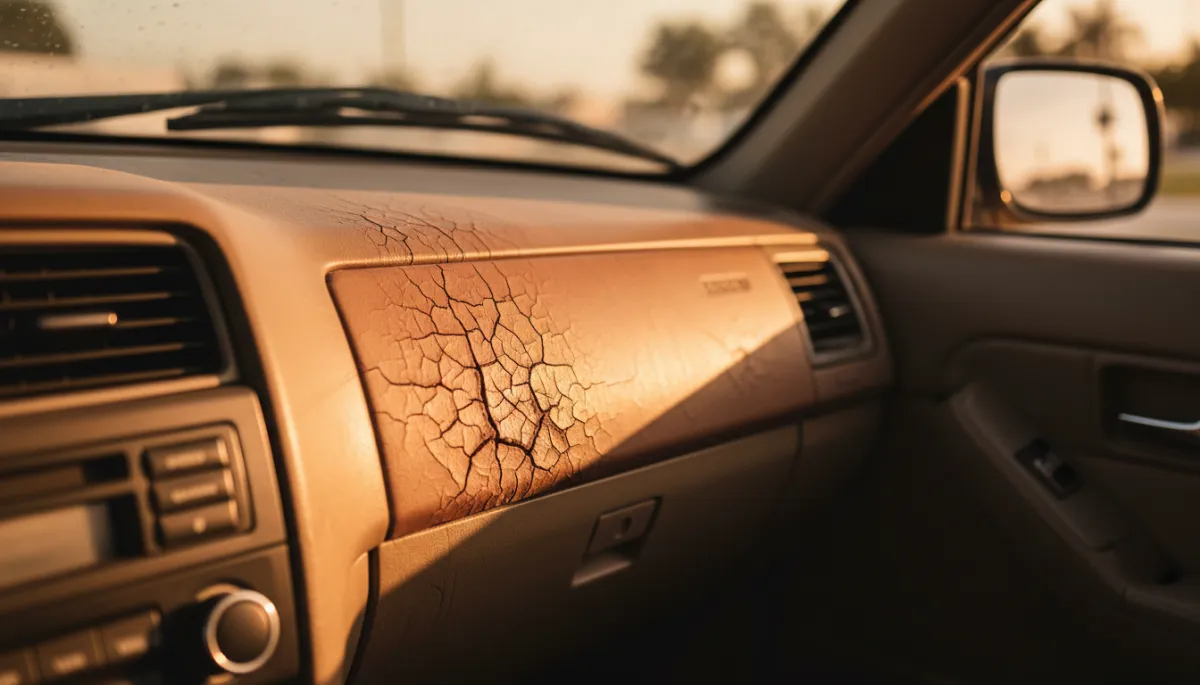
The leather feels tight. The dashboard looks a shade lighter than it did six months ago. A hairline crack has appeared in the center console where you've never noticed one before.
You didn't leave your car in the Sahara. You parked it in Miami-Dade on an ordinary Tuesday morning. And this is exactly the kind of damage that most Miami drivers don't connect to UV exposure — until it's too late to reverse.
What UV Rays Are Actually Doing to Your Car
Most people think of UV damage as a sunburn problem. But your car's interior isn't just getting burned — it's being systematically broken down at a molecular level, every single time it sits in the Miami sun.
Sunlight contains three types of radiation that affect your car interior: UV-A rays, UV-B rays, and infrared radiation. UV-A rays penetrate deep into materials — leather, vinyl, fabric — and break down the chemical bonds that give those materials their strength and color. UV-B rays attack surface layers, causing fading and surface cracking. Infrared radiation is pure heat energy, and in a parked car in South Florida, that heat builds to extraordinary levels.
Think of it like SPF for your car. Without protection, your car's interior is essentially sunbathing, every single day, with no sunscreen on. A car parked in direct Miami sun can reach interior temperatures of 150°F to 180°F within 30 minutes — even on a partially cloudy day. At those temperatures, heat works alongside UV to accelerate every form of material degradation. It's not just the light. It's the light plus the heat, working together, hour after hour, in one of the most UV-intense cities in the continental United States.
The Damage Report: What's Really Happening Inside Your Car
Let's get specific about what this actually looks like inside a car that hasn't been protected.
Leather seats and upholstery: UV rays break down the collagen-like fibers in natural and synthetic leather. This causes what you eventually see as cracking — but before the cracks appear, the leather first loses its natural oils, becoming brittle and stiff. By the time you see the cracks, significant structural damage has already occurred.
Dashboard and instrument panel: The dashboard is one of the most UV-exposed surfaces in your vehicle. The polymers and pigments that give it color and flexibility degrade under sustained UV exposure. You'll notice fading first — that dull, chalky appearance that no amount of detailing product seems to fix. Then warping, as the heat differential between sun-exposed and shaded areas causes the plastic to expand unevenly.
Steering wheel: The steering wheel takes daily UV exposure plus oil from your hands. This combination accelerates cracking and peeling on leather-wrapped wheels. A steering wheel in a Miami car that's three or four years old with no UV protection can look like it belongs in a ten-year-old vehicle.
Carpets and headliners: Carpet fibers bleach out in patterns that follow where sunlight streams in through untinted windows. Headliners — the fabric ceiling of your car — sag and discolor from the combination of heat and UV exposure over time.
None of this happens dramatically, all at once. It's slow, cumulative, invisible — until it isn't. That's what makes UV damage so expensive: by the time you notice it, you're looking at interior restoration costs that can run well into the thousands.
Why South Florida Makes It Worse Than Almost Anywhere Else
Miami sits far enough south that the sun's angle is consistently intense year-round. There's no real off-season for UV exposure here. No significant break in winter. No respite.
Miami-Dade consistently ranks in the top tier of U.S. metro areas for UV index. On a clear summer day in Coral Gables, Westchester, or Doral, the UV index routinely hits 10 or 11 — classified as extreme. That's not just dangerous for skin; it's brutal for any unprotected material.
Add to that the humidity. South Florida's moisture-laden air doesn't just make it feel hotter — humidity accelerates the breakdown of adhesives and coatings. Any tinting adhesive that isn't professional-grade will fail faster here than it would in drier climates. You've seen the results on other people's cars: purple-tinted windows, bubbling film, peeling edges at the corners.

Why Cheap Tint Actually Makes the Problem Worse
Here's what most Miami drivers don't realize: a cheap dyed window film can feel like protection, but provide almost none when it comes to UV and heat rejection.
Entry-level dyed films are primarily designed to reduce visible light — they make your car look darker. But many offer minimal infrared or UV rejection. The dye absorbs some heat, yes. But much of that heat is then transferred into the cabin anyway. And the dye itself degrades in Miami's conditions. You've seen it: the purple tint, the bubbling film, the peeling edges. That's UV and humidity doing what they always do to cheap materials.
A bubbling, degraded film is worse than no film in one specific way: it creates a false sense of protection. You think you're covered. You're not. The car looks tinted; the UV damage continues. By the time you notice the film failing, your interior has been quietly deteriorating for years.
The 3M Ceramic Film Solution: How It Actually Works
3M Ceramic Series films don't use dye at all. Instead, they use nano-ceramic particles — microscopic ceramic elements embedded in the film matrix — that reject infrared and UV radiation without relying on color or tint depth.
This is the difference between blocking light and rejecting energy. A 3M Ceramic film can reject up to 99% of UV rays and significantly reduce infrared heat entering the cabin — without necessarily making your car look dark. Some of the most protective configurations are nearly clear from the outside.
In practical Miami terms, this means:
- Interior temperatures in parked cars drop noticeably with quality ceramic film installed
- Leather and vinyl last significantly longer with consistent UV blockage
- Your A/C doesn't have to work as hard — real comfort savings on the daily drive from Sweetwater to Miami International Airport in August
- 3M's warranty covers the film against bubbling, peeling, and color change
As a 3M Authorized Dealer, Best Window Tinting backs every install with that manufacturer's warranty. No mobile gimmicks. No parking lot work. Every install is done in-shop, where conditions are controlled and the work is done right the first time.
Serving Miami-Dade's Neighborhoods
Best Window Tinting is located at 7284 NW 8th St in Miami — a central location that makes them easy to reach from virtually every neighborhood in Miami-Dade.
If you're coming from Flagami, you're practically around the corner. Little Havana customers are minutes away on Calle Ocho. Drivers from Westchester and West Miami make the quick hop over regularly — those neighborhoods see heavy direct sun with minimal tree cover on the main corridors.
From Doral and Sweetwater, the drive over NW 8th Street or the Dolphin Expressway takes just minutes. If you're near Miami International Airport — whether you work in aviation, hospitality, or logistics — you already know how punishing airport parking and high-mileage driving are on car interiors.
Customers from Coral Gables, Coconut Grove, and South Miami make the drive regularly for quality they trust. With a 4.8-star average across 812+ Google reviews, the reputation speaks for itself — and keeps people coming back with their second cars, their parents' cars, and their business vehicles.
Best Window Tinting & Car Accessories
Miami-Dade's 3M Authorized Dealer
📍 7284 NW 8th St, Miami, FL 33126
🌐 bestwindowtinting.weebly.com
⭐ 4.8 Stars · 812+ Google Reviews
✅ 3M Authorized Dealer | Ceramic Film | Commercial & Residential Tinting
✅ In-shop only — we do not do mobile tinting (quality demands it)
Follow us on Instagram @bestwindowtinting and Facebook Best Window Tinting Miami for before/after shots, tinting tips, and Miami car culture. Leave us a review on Google — it means the world to us: https://share.google/SeejrUMdvt2gHaz2L
Don't Wait Until the Leather Cracks
The hardest part of UV damage is that it looks like time. People look at a faded dashboard or cracked leather seat and think, the car's just getting old. But age and sun damage are not the same thing. A car protected with quality ceramic film can have an interior that looks genuinely newer at 80,000 miles than an unprotected car at 30,000.
If your car is parked in Miami-Dade, the question isn't whether UV damage is happening. It's how much longer you're going to let it.
Best Window Tinting has been protecting Miami car interiors for years. The shop is right on NW 8th Street, the team knows what they're doing, and 812+ Google reviews confirm it. Stop by 7284 NW 8th St or call 786-917-2171 — your leather, your dashboard, and your steering wheel will thank you.
