Two Miami Cars. One Decision. Here's What Three Years of Florida Sun Did to the One Without Window Tint.
Two Miami Cars. One Decision. Here’s What Three Years of Florida Sun Did to the One Without Window Tint.

In the summer of 2022, two neighbors in Flagami — both longtime Miami-Dade residents, both car people — walked off the lot with the same car. Same make. Same model. Same color. A midnight-blue Honda CR-V. They’d even negotiated nearly identical prices at the same dealership on Bird Road.
Three years later, Carlos’s CR-V looks like it just rolled off the showroom floor. The leather seats are supple, softly conditioned, without a single stress crack. The dashboard — that long, sweeping panel that takes the full brunt of a Miami afternoon — is smooth, unwarped, and as dark and rich as the day he bought it. The steering wheel still has its original textured grip. Inside that car, on a sweltering August afternoon in Flagami, it’s warm but manageable. It doesn’t smell like baked plastic and dried-out adhesive.
Miguel’s CR-V tells a completely different story.
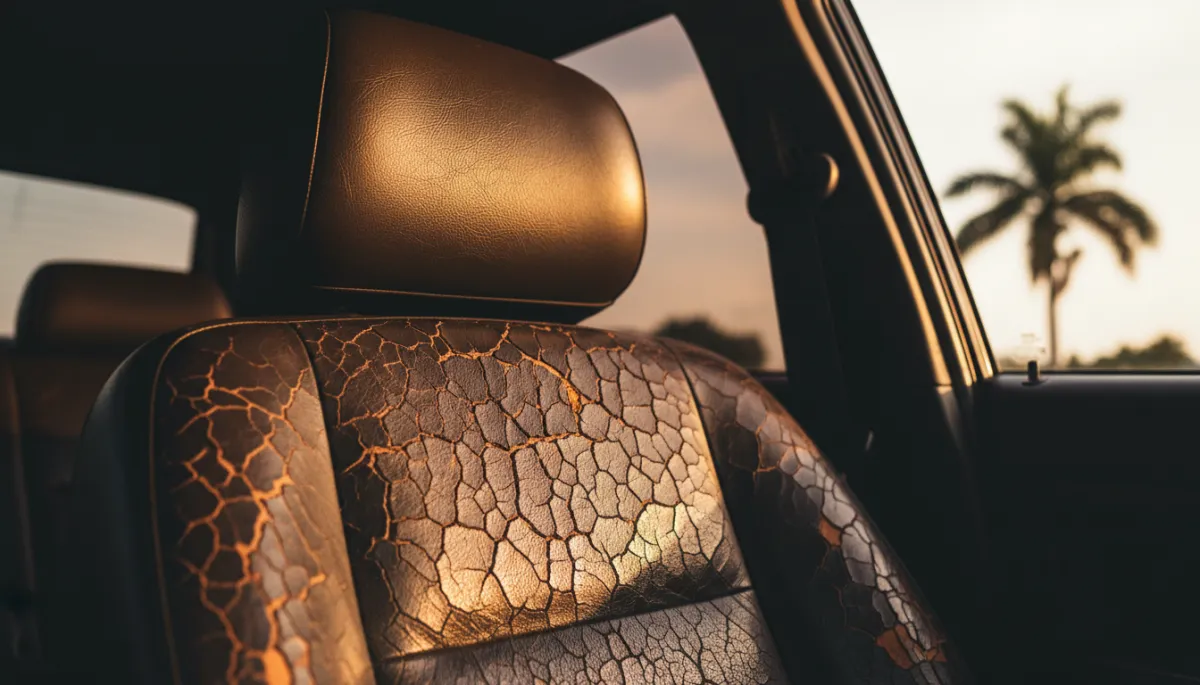
The leather on his driver’s seat has cracked along two stress lines, revealing a pale, dried-out substrate underneath. The top of the dashboard has developed a faint but unmistakable warp — that slow-motion buckle that happens when vinyl bakes at 160°F for three consecutive Florida summers. His steering wheel’s grip texture has worn smooth on the sides where his palms rest daily. The door panel leather has started to separate at the edges. When Miguel opens the car door after a long day near the Airport area, the first wave of air that hits him is thick with the smell of hot plastic and aged material.
Both men drive the same roads. Same Florida sun. Same NW 8th St, same I-836, same weekend errands through Westchester and Sweetwater and out toward Doral.
One difference: Carlos tinted his CR-V three years ago at Best Window Tinting & Car Accessories on NW 8th St in Miami. Miguel didn’t.
What UV and Heat Actually Do to Your Car’s Interior — and Why Standard Glass Doesn’t Stop It
This isn’t a scare story. It’s chemistry and physics — and once you understand what’s actually happening inside your parked car, you can’t unsee it every time you pull into a parking lot under the Miami sun.
Florida automotive glass — even the laminated safety glass in your windshield and the tempered glass in your side and rear windows — is largely transparent to ultraviolet radiation. UV-A rays (wavelengths between 315–400 nanometers) pass straight through standard automotive glass with almost no resistance. UV-B rays (280–315 nm) are partially filtered by the laminate layer in windshields, but your side windows and rear glass offer virtually no UV protection at all. In practical terms, your car’s interior is exposed to UV radiation almost as if the glass weren’t there.
UV-A is the primary culprit behind color fading and material degradation. It attacks the molecular bonds in leather dyes, vinyl polymers, and the protective coatings applied to dashboards during manufacturing. This process — photodegradation — is invisible and constant. It doesn’t leave a visible mark after one afternoon. But after one hundred afternoons? After three hundred? The cumulative breakdown is exactly what you see in Miguel’s driver’s seat.
Then there’s heat — and it compounds everything.
A car parked in direct Miami sunlight can reach interior temperatures of 130–170°F within 20 minutes. This is the greenhouse effect at work: solar energy passes through the glass and converts to heat when it strikes the dark surfaces inside your cabin. That heat can’t escape back through the glass as efficiently as it entered, so temperatures climb through the afternoon hours. Your dashboard, seats, and steering wheel absorb and retain this heat across the entire workday.
Leather dries and loses its natural oils when sustained temperatures exceed 120°F. Once it cracks, it doesn’t heal — you’re looking at conditioning treatments at best and panel replacement at worst. Vinyl dashboards soften and deform under prolonged heat, developing warps and surface distortions that no detail shop can reverse. Steering wheel materials — the carefully engineered blend of rubber, leather, and polymer that gives a wheel its grip and feel — harden and lose their texture. Door panel adhesives weaken. Dashboard electronics face accelerated wear from repeated thermal cycling across Miami’s long, intense summers.
In Doral, in Sweetwater, in Coral Gables, in Westchester, in Little Havana — anywhere in Miami-Dade — your car is fighting this battle every single day you leave it outside. Most drivers simply don’t realize how far ahead the sun already is until they’re sitting across a trade-in desk hearing an offer that doesn’t reflect what they believed their car was worth.

Why 3M Ceramic Film Is a Completely Different Category of Protection
Not all window tint is the same product. Miami’s car tint market has plenty of budget options — some inexpensive, some quick-applied at mobile setups or discount shops. If you’ve spent time on Miami streets, you’ve seen the results: bubbled film, tint that’s turned purple, edges that started peeling before the car hit 50,000 miles. Budget film is everywhere. And it delivers a fraction of the protection the marketing implies.
Best Window Tinting & Car Accessories installs 3M Ceramic Series window film. Here’s what that means in practice:
UV protection at 99%: 3M Ceramic film blocks up to 99% of UV-A and UV-B radiation. Not “significantly reduces” — up to 99%. The UV that cracked Miguel’s leather and warped his dashboard would have been stopped at the glass. Carlos’s CR-V has absorbed Miami sun for three years and looks like it was just detailed because the UV that would have destroyed it simply never made it inside.
Meaningful heat rejection: Ceramic nano-particles in the film reflect and absorb infrared radiation — the part of the solar spectrum you feel as heat — without relying on metallic layers. Carlos’s car interior is genuinely cooler in August because less heat is entering the vehicle in the first place. His air conditioning isn’t fighting solar load all day; it’s working from a position of advantage.
Zero signal interference: Because it’s metal-free, 3M Ceramic film doesn’t degrade GPS signals, wireless CarPlay, Bluetooth connectivity, or toll transponder performance. Some metallic tint films common in budget shops can interfere with wireless signals. With ceramic, none of that is a concern.
Clear optical performance: Ceramic film maintains clean, undistorted visibility in all light conditions. You’re not trading nighttime driving safety for UV protection. The glass performs as glass — just with a critical UV and heat barrier added.
Manufacturer warranty: Because Best Window Tinting is a certified 3M Authorized Dealer, every installation is backed by 3M’s manufacturer warranty. Not a shop promise. A documented, manufacturer-level warranty on the film itself. That distinction matters when you’re protecting a vehicle you plan to keep or eventually sell at full value.
How Best Window Tinting Serves Miami-Dade Drivers
Best Window Tinting & Car Accessories has built its reputation across Miami-Dade the way trusted shops do: consistent quality, one installation at a time, for years. Customers make the drive from Doral, from Sweetwater, from Little Havana, from Coral Gables — because the combination of 3M-certified film, professional installation environment, and manufacturer-backed credentials isn’t available on every block in Miami-Dade.

One point worth understanding: Best Window Tinting is a shop-only operation. They do not offer mobile tinting — and that’s a deliberate choice, not a limitation. Film application requires controlled ambient temperature, dust-free air, proper surface preparation, and adequate curing conditions. A mobile install done in a parking lot, in South Florida humidity and ambient wind, cannot replicate those conditions. A professionally shop-applied 3M installation, completed correctly at 7284 NW 8th St, will outlast a field install by years. For customers coming from the Airport area, Flagami, and Westchester, the short drive to NW 8th St is one of the most straightforward trade-offs they’ll make for their vehicle.
The shop works with all vehicle types: compact cars, SUVs, trucks, luxury vehicles, and daily commuters. Whether you’re protecting a lease to return in pristine condition, shielding a new purchase from day one, or finally addressing a car that’s already absorbed three Miami summers of UV damage — the team at Best Window Tinting can match you with the right film and walk you through the process.
For those thinking ahead to resale: a preserved interior negotiates from a position of strength. A CR-V with supple leather and an unwarped dashboard commands a better trade-in than the same model with a baked, degraded cabin. Window tinting, framed correctly, is a maintenance investment with a measurable return at the end of ownership.
The Bottom Line: Your Interior Is Already Being Damaged — Here’s How to Stop It
If your car is sitting outside right now without window film, UV radiation is penetrating your glass and degrading your interior materials. Slowly. Invisibly. Continuously. And unlike an oil change or a brake job, the damage it causes doesn’t reset — it accumulates, layer by invisible layer, across every Miami afternoon.
Carlos made one appointment at Best Window Tinting on NW 8th St three years ago. His CR-V’s interior will still look excellent in 2028 — and well beyond. Miguel is looking at leather conditioning, panel work, and a difficult trade-in conversation that didn’t have to happen.
Miami delivers approximately 260 days of intense direct sunlight per year. Every day without UV-blocking ceramic film is another day of silent, irreversible damage compounding against your interior. The decision, genuinely, is as simple as it appears.
Ready to Protect Your Car’s Interior?
Best Window Tinting & Car Accessories is Miami-Dade’s trusted 3M Authorized Dealer — serving Flagami, Westchester, Doral, Sweetwater, Little Havana, and the Airport area from our professional shop.
- 📍 7284 NW 8th St, Miami, FL 33126 — Get Directions
- 📞 Call Us: 786-917-2171
- 🌐 Visit Our Website
- ⭐ 4.8 Stars — 812+ Google Reviews — See what Miami-Dade drivers are saying.
We do NOT offer mobile tinting. All installations are performed in our professional, climate-controlled shop at 7284 NW 8th St for quality, precision, and durability you can count on.
Follow us on Instagram @bestwindowtinting and Facebook Best Window Tinting Miami for before/after shots, tinting tips, and Miami car culture. Leave us a review on Google — it means the world to us: https://share.google/SeejrUMdvt2gHaz2L
