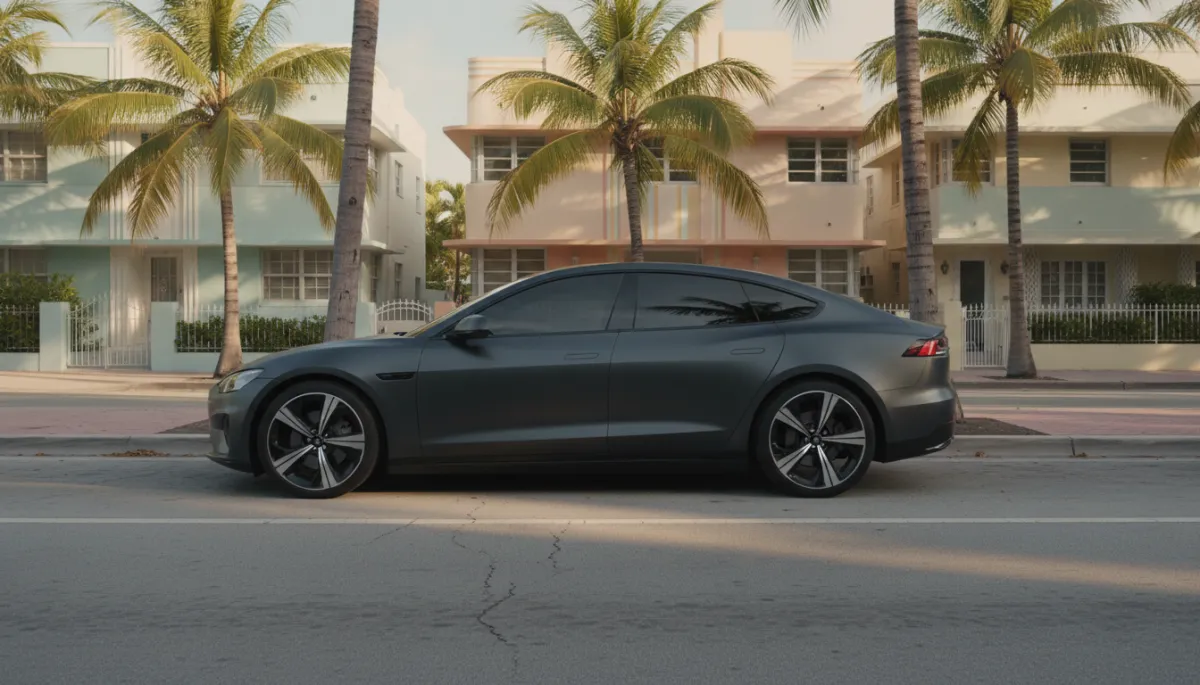
Electric Vehicle Window Tinting in Miami: What Every EV Owner Needs to Know
Nobody warned you about this when you drove your new EV off the lot in Doral. Not the delivery specialist, not the app, not the pristine owner's manual you saved to your phone and probably never opened.
Your electric vehicle is a masterpiece of modern engineering — regenerative braking that feeds energy back into the battery every time you slow down, over-the-air software updates that make it smarter while you sleep, an interior that feels less like a car and more like a living room designed by someone who had strong opinions about Scandinavian minimalism. You chose it carefully. You paid for it thoughtfully.
And on a Tuesday morning in August, parked outside a strip mall on NW 8th Street in Flagami, it sits baking in 96°F Miami heat while ultraviolet radiation quietly does what South Florida sun always does: it starts taking things apart.
The good news — the genuinely effortless news — is that the solution to all of it exists. The heat building inside the cabin. The range loss from your overworked HVAC. The fading leather. The cracking dashboard. The morning glare on I-95 that turns the causeway into a blinding wall of light. All of it, solved in a single afternoon at a professional shop. That's the whole answer.
Professional 3M Ceramic window film, installed by an authorized dealer right here in Miami-Dade, is the effortless solution that EV owners from Coral Gables to Coconut Grove, from Doral to Sweetwater, are quietly adopting — and wishing they had done on day one.
The Miami Heat Problem No App Update Can Fix

Miami-Dade averages over 250 sunny days a year. The sun angle is steep, the humidity amplifies radiant heat, and summer in South Florida stretches from April through November — nine months where your parked car becomes a solar oven by 10 a.m.
On a typical sunny Miami day, the cabin temperature inside an unprotected vehicle can exceed 160°F within an hour of parking. Your EV's thermal management system is designed to prevent the battery pack from reaching dangerous temperatures — but that cooling function draws power. Battery power. Before you've even touched the accelerator, your vehicle has been working hard just to stay cool, and that work comes directly out of your available daily range.
Then you open the door. The heat that hits you is almost physical. You crank the air conditioning — not for comfort, but just to make the cabin drivable — and the HVAC load takes another slice out of your range. Miami drivers commuting on 836 or the Palmetto through Doral and West Miami already navigate some of the most heat-exposed driving corridors in the country. Without solar protection, that daily commute costs range you'd rather have at the end of the day.
This is the quiet drain that no software update can address. It's physics: solar heat entering through glass is the source problem, and the only permanent way to solve it is to stop it at the glass — before it ever reaches your battery's thermal management system.
Your EV's Interior Was Not Designed for Miami
Walk into any EV showroom and notice how the design celebrates transparency. Panoramic glass roofs. Large sweeping side windows. Windshields that stretch into the headliner. These aren't accidents — they're intentional design choices that make modern EVs feel spacious, connected, and genuinely futuristic.
In most American climates, they work beautifully. In Miami, they concentrate relentless subtropical sunlight onto the most premium materials the automotive industry has ever installed inside a vehicle.
The white vegan leather in a Tesla Model Y is striking — clean, modern, unmistakable. It's also a material that, under sustained UV exposure in South Florida, begins to yellow and develop surface stress lines within a few years. The open-pore wood trim in a Lucid Air — real, tactile, carefully grain-matched — fades under the same sun that makes Miami gorgeous. The panoramic Hyperscreen in the Mercedes EQS is the most sophisticated automotive display ever produced; the solar loading it receives through an unprotected panoramic roof was not part of the original design brief.
Rivian owners parking near Grove Harbour in Coconut Grove. BMW iX owners along Miracle Mile in Coral Gables. Hyundai IONIQ 6 drivers commuting from Sweetwater to Brickell. All of them watching Miami do what Miami does — quietly, invisibly, and expensively — to interiors built from materials that cost thousands to restore once sun-damaged.
Dashboard cracking. Steering wheel surface degradation. Leather discoloration. These aren't warranty items. They're environmental wear. And in Miami-Dade County, the environment accelerates everything.
The Solution Is Simpler Than You Think

One visit. One afternoon. One layer of professional-grade nano-ceramic film between your interior and the Miami sun — and the problem is solved. Not managed. Not reduced. Solved.
3M Ceramic window film is engineered using advanced nano-ceramic particle technology that rejects heat and ultraviolet radiation at the glass surface, before it enters the cabin. Here is what it actually does:
It blocks up to 60% of solar heat. Not your air conditioning compensating for heat that's already inside the cabin — heat rejection at the source, before it becomes your HVAC system's problem. Less heat entering means your AC runs less aggressively, your battery's thermal management works less hard in Miami's summer conditions, and you consistently arrive with more usable range.
It filters out 99% or more of ultraviolet radiation. The UV wavelengths that degrade vegan leather, fade wood grain, crack dashboards, and yellow plastic trim panels — blocked before they reach your interior. Your white Tesla seats stay white. Your Rivian's wood trim keeps its warmth and color. Your dashboard stays supple and unblemished. Year after year, regardless of how many Miami summers pass.
It eliminates the glare that South Florida produces in abundance. Anyone who has driven east on Flagler Street at 7:45 a.m. with the sun cutting through the windshield knows what Miami glare feels like. Anyone who has crossed the MacArthur Causeway with Biscayne Bay reflecting morning light directly at eye level understands the problem intimately. Ceramic film reduces the high-frequency optical scatter that causes eye fatigue and forced squinting — precisely when you need your full attention on the road.
It adds a layer of privacy and visual security. EV interiors — with large touchscreens, visible storage areas, and premium materials — draw attention in public spaces. Professionally tinted windows reduce what's visible from outside, making your vehicle a less obvious target in Miami's busy parking areas, garages, and crowded street-level spaces.
All of this, installed in a single professional visit, covered by a 3M manufacturer's warranty, and maintenance-free from that day forward. One afternoon. Permanent protection.
Why 3M Ceramic — And Why It Matters for EV Owners Specifically
Not all window film performs equally, and for EV owners, one specific limitation of older film technology becomes a real operational concern: electromagnetic interference.
Metalized film — once the premium choice for heat rejection — uses metal particles to reflect solar energy. It performs reasonably well at heat rejection, but metal particles in window film create radio frequency interference that affects GPS lock, cellular connectivity, satellite radio, and the Wi-Fi signal your EV relies on for over-the-air software updates and remote app access. If your vehicle updates itself overnight via cellular connection, or if you depend on real-time navigation and traffic syncing, metalized film can degrade or interrupt those functions at exactly the moments you depend on them most.
3M Ceramic film contains no metal. Its nano-ceramic particles reject solar energy optically — not electromagnetically — which means your GPS locks cleanly, your software updates run without signal degradation, and your phone app connects to your vehicle with no interference. For a car as electronically sophisticated as a modern EV, signal clarity is not a minor consideration.
Dyed film, the budget alternative, lacks the durability to survive Miami's conditions. South Florida humidity causes premature adhesion failure and bubbling in dyed tint, and sustained UV exposure shifts the dye toward purple within months of installation. It requires replacement before it's truly paid for itself — false economy in a climate that tests everything.
From Flagami to Coral Gables: One Trusted Shop for All of Miami-Dade

Best Window Tinting & Car Accessories is located at 7284 NW 8th St in the heart of Flagami — positioned naturally at the center of the neighborhoods where Miami's EV owners live, work, and commute. Minutes west from Little Havana and West Miami. Quick access from Westchester and South Miami via the Palmetto. An easy run from the Airport area along NW 36th Street. Straightforward from Coral Gables and Coconut Grove, and familiar territory for drivers coming in from Sweetwater and Doral.
They are a certified 3M Authorized Dealer. This is not a marketing claim — it means the film they install meets 3M's manufacturing and application standards, the installation is backed by a factory-issued warranty, and their technicians are trained specifically on modern vehicles, including the curved panoramic glass surfaces and expansive window profiles that define today's EV design language.
All work is performed in-shop. No mobile tinting — ever. Film adhesion quality, edge alignment, and long-term durability in Miami's humidity all depend on climate-controlled installation conditions and professional-grade tools. For a vehicle built with the engineering precision of a modern EV, the installation deserves the same standard.
4.8 stars across 812+ Google reviews. A reputation built over years of serving drivers across Miami-Dade County. If you've been searching for the best window tinting near Flagami, the best 3M ceramic film near Coral Gables, or simply a trusted car tint shop near me in Miami — the search is over.
Visit Best Window Tinting & Car Accessories
Best Window Tinting & Car Accessories in Miami-Dade
📍 7284 NW 8th St, Miami, FL 33126
🌐 bestwindowtinting.weebly.com
⭐ 4.8 Stars · 812+ Google Reviews
🏆 3M Authorized Dealer · Ceramic Film · Commercial & Residential · NO mobile tint
Follow us on Instagram @bestwindowtinting and Facebook Best Window Tinting Miami for before/after shots, tinting tips, and Miami car culture. Leave us a review on Google — it means the world to us: https://share.google/SeejrUMdvt2gHaz2L
